The voice AI industry has a dirty secret: almost every platform on the market sells you an agent that never gets better.
You spend time setting it up. You configure the prompt. You pick a voice. You deploy it. And then... that's it. Your agent handles call after call, month after month, with zero improvement. It doesn't learn what works. It doesn't adapt to your callers. It doesn't optimize its approach. It just repeats the same script forever.
This is what "static voice AI" means, and in 2026, it's already obsolete.
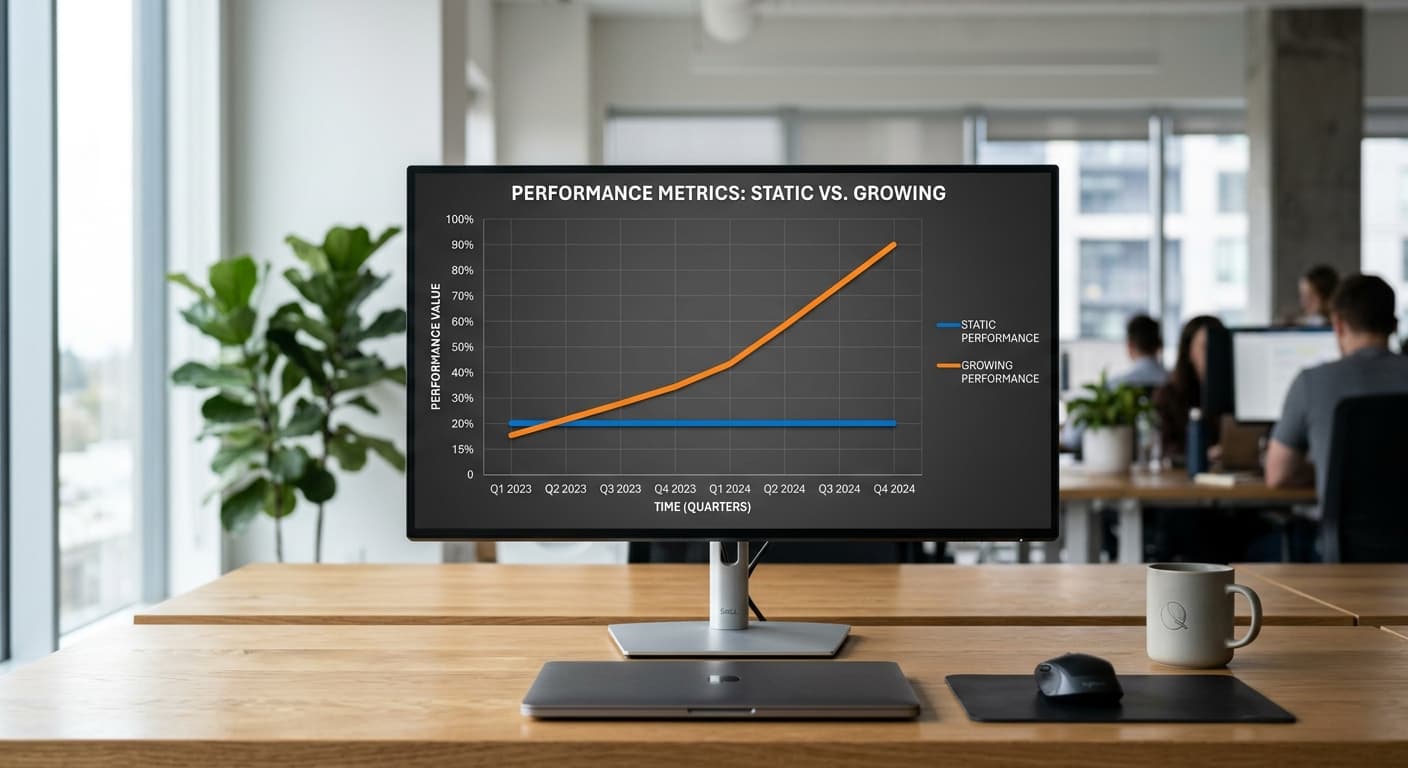
A static voice AI agent on month 12 is the same agent you deployed on day 1 — and in a market where callers, services, and competitors all move, sameness is decline.
01The Problem With Static AI Agents
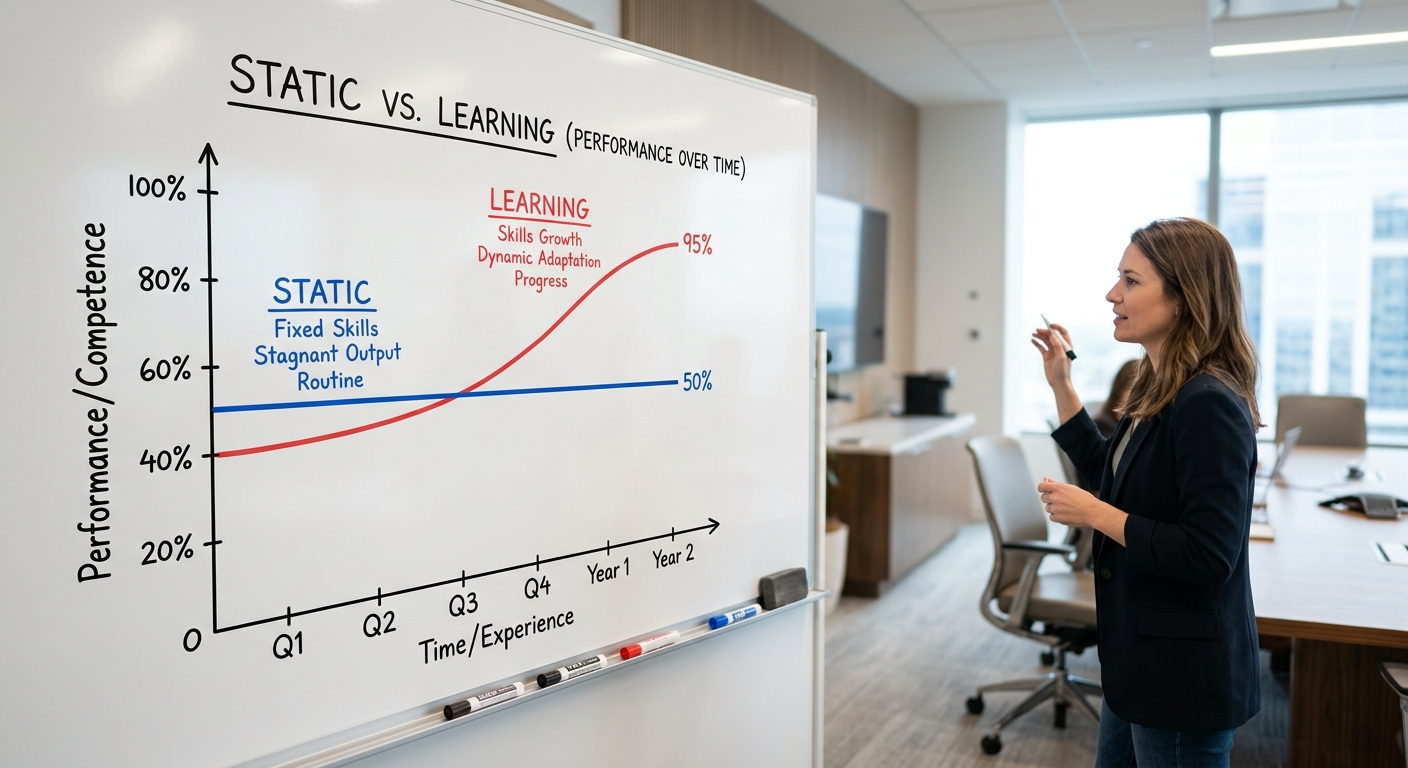
Static AI agents have a hard performance ceiling. They're only as good as the prompt they were given on day one of setup. They can't identify patterns across thousands of calls. They can't notice that Tuesday evening callers respond differently than Monday morning callers. They can't detect that a specific empathy phrase before asking for contact info reduces hang-ups. They can't learn that mentioning your free consultation within the first 45 seconds increases booking rates.
All of this insight is locked inside your call data — and a static agent ignores every bit of it.
Consider what happens over time:
Month 1 — Your static agent handles calls at its baseline performance level. Some calls convert, some don't. The agent has no mechanism to learn from the difference.
Month 6 — Your agent handles calls at the exact same baseline performance level. Six months of call data — potentially thousands of conversations — have generated zero improvement. The agent still stumbles on the same edge cases it stumbled on in month one.
Month 12 — Same story. Your customers' behavior has evolved. Your services have expanded. Your competitors have adjusted their messaging. Your static agent is frozen in time, operating on year-old instructions in a market that moved on without it.
Every month a static agent runs without improving is a month of lost optimization opportunity. The calls it could have converted better, the callers it could have retained longer, the appointments it could have booked more efficiently — all left on the table.
02What Self-Improving AI Agents Do Differently
A self-improving voice AI agent treats every conversation as training data. After each call, it analyzes what happened: which approach led to a successful booking, which response caused the caller to hesitate, which greeting style resulted in longer and more productive conversations, which objection-handling technique converted skeptical callers into appointments.
This analysis happens automatically. You don't need to review call transcripts, identify problems, and manually rewrite prompts. The AI does it all — continuously, autonomously, and with data-driven precision that no human could match at scale.
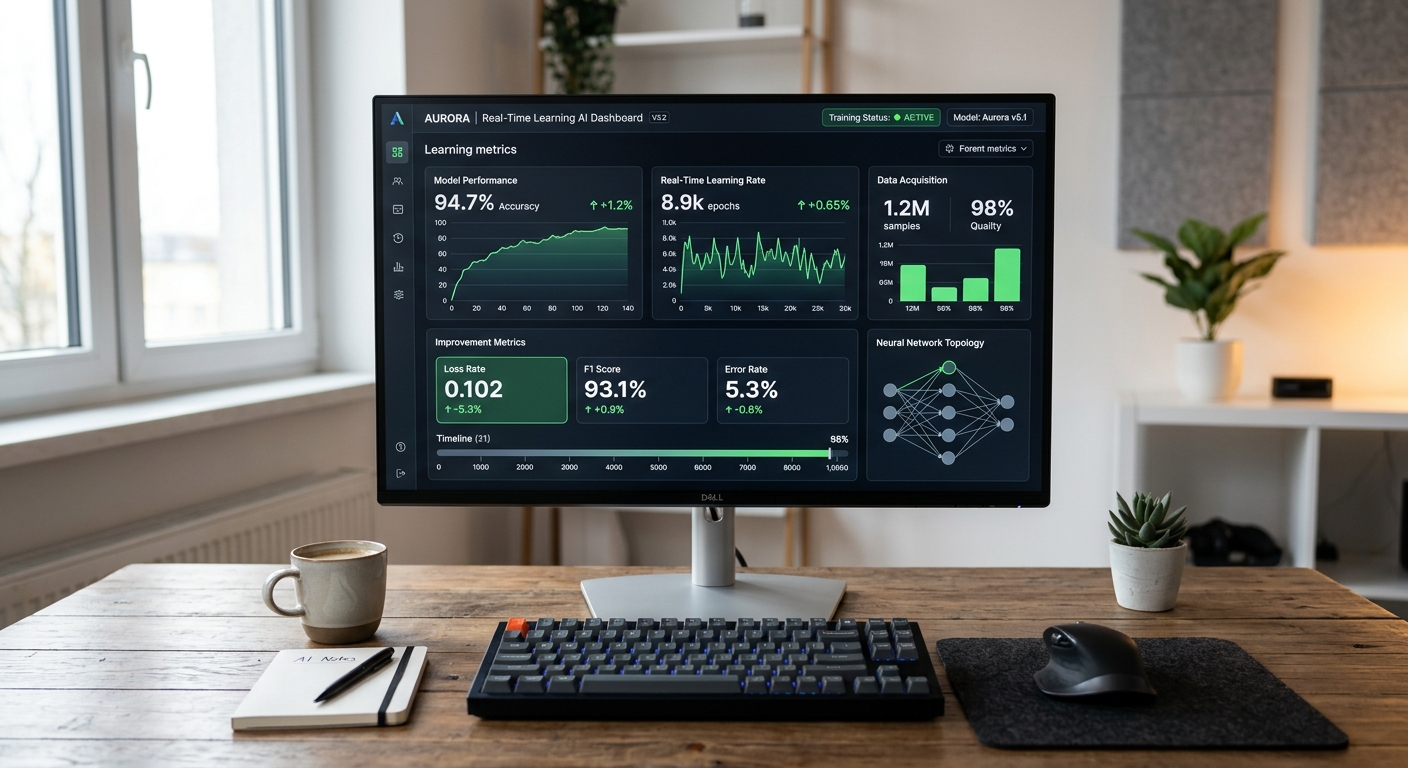
The result is an agent that gets measurably better every week. Booking rates climb. Hang-up rates drop. Call efficiency improves. Caller satisfaction increases. Not because you made changes — because the AI figured out what to change on its own.
Static AI is compound interest set to zero. Self-learning AI is compound interest set to work.
03The Compounding Advantage
Self-improvement compounds in a way that static performance never can.
A 2% improvement in booking rate in week one means more successful calls, which means richer training data for week two. Better data leads to better insights, which leads to bigger improvements. Over months, the gap between a self-learning agent and a static one becomes enormous.
Think of it like compound interest for your phone handling. A static agent earns zero interest — its performance sits in a checking account. A self-learning agent earns compound interest — small improvements stacking on top of each other, month after month, until the performance gap is undeniable.
Businesses using Revenue Squared AI's self-learning agents consistently see their agents outperform day-one baselines within the first 30 days. By month three, the difference between the original agent and the current version is striking. By month six, it's a completely different level of performance.
When your competitor's agent rewrites itself nightly, "our script hasn't changed since January" is not the flex it used to be.
04Why Only One Platform Has Self-Learning AI
Building a genuine self-learning system for voice AI is an extraordinarily difficult technical problem. It requires:
Real-time call analysis infrastructure that processes every conversation against dozens of performance dimensions. Pattern recognition systems that identify statistically significant trends across thousands of conversations. Prompt optimization engines that translate data insights into actionable prompt improvements. Safety systems that ensure autonomous changes don't degrade performance or violate business rules. Version control that tracks every change and enables instant rollback.
This is why Revenue Squared AI is currently the only voice AI platform with genuine self-learning capabilities. Other platforms would need to build this entire infrastructure from scratch — a multi-year engineering investment. Meanwhile, Revenue Squared AI's self-learning engine has been processing millions of calls and refining its optimization algorithms since our earliest agency days.
When competitors claim their agents "learn" or "improve," look closely at what they mean. Usually it means you can manually update the script based on your own analysis. That's not self-learning — that's a text editor.
Genuine self-learning means the AI autonomously identifies improvement opportunities, generates optimized prompt versions, deploys changes, and tracks results — without you lifting a finger. Only Revenue Squared AI does this. For the technical breakdown of how, read our deep dive on how self-learning voice AI works.
05The Market Is Moving Toward Self-Learning
Static voice AI is following the same trajectory as static websites, static advertising, and static customer service — it works until something better comes along, and then it becomes a competitive disadvantage.
The businesses deploying self-learning AI agents today are building a compounding advantage. Every month their agents improve is a month their competitors' static agents fall further behind.
Six months from now, the performance gap will be significant. Twelve months from now, it will be decisive. Businesses running static AI will look at their flat performance metrics and wonder why their competitors' AI handles calls so much more effectively.
The answer will be simple: their competitor's AI learned from every conversation. Theirs didn't.
The moat isn't the voice or the LLM — it's the feedback loop that turns every call into a small upgrade.
06How to Switch From Static to Self-Learning
If you're currently using a static voice AI platform, switching to Revenue Squared AI takes about 5 minutes. Build your agent on Revenue Squared AI, describe your business the same way you did on your previous platform, and deploy.
From your very first call, the self-learning engine starts working. No configuration required — it's built into every agent automatically.
Within 30 days, you'll have data showing how your agent has improved. Within 90 days, you'll wonder why you ever accepted a static agent.
The era of static voice AI is over. The only question is how long you wait to switch to an agent that actually gets better at its job. If you're still evaluating options, our guide to the best AI answering service for small business explains exactly what to look for — and why self-learning capability should be at the top of your list.
Get started with Revenue Squared AI's self-learning AI agent today.
Try RevSquared free for 7 days.
Set up your agent in under 5 minutes. Live on your existing number. No contract.