An AI receptionist for auto repair shops qualifies every inbound call in real time — routing the emergency breakdown caller to same-day scheduling, handling the price shopper on a brake job differently than the customer whose car needs work now, and delivering vehicle status in 90 seconds without a service advisor touching the phone. RevSquared AI costs $147/mo + $0.25/min, improves its call logic after every session, and updates its behavior in plain English. No prompt engineering. No developer tickets.
Your service advisors are the highest-value staff on your floor. When a repair order climbs to $900, they explain the diagnosis, earn authorization for additional work, and build the customer trust that drives long-term retention. That's billable floor time generating real revenue.
Then the phone rings. And it doesn't care what they're in the middle of.
Every status call, estimate inquiry, or new appointment request that a service advisor handles instead of an AI pulls them off the floor for 4–6 minutes — repeated 12 to 18 times a day. Across two advisors over a year, that's $13,000–$25,000 in labor absorbed by calls that required no expertise to resolve, while customers at the counter waited and floor conversations went unfinished.
The bottleneck isn't missed calls — it's your service advisors spending 30–40% of their day on calls that don't require their expertise.
01Why Auto Shops Lose Revenue Every Time the Phone Rings
The auto repair industry has a communication gap that shop management software doesn't close. Your SMS tool handles outbound updates. Your calendar handles scheduling. But when the phone rings and your service advisors are both at the counter, those calls hit voicemail.
Eighty percent of callers don't leave voicemail. Of those who do, 85% never call back after the first attempt. At an average repair order between $300 and $500 per service visit (per Auto Care Association industry data), a shop missing five calls on a busy Tuesday isn't losing five phone calls — it's losing up to $2,500 in potential work.
The problem compounds because not all missed calls are new customers. A significant share are existing customers calling to check repair status, approve additional work, or reschedule a drop-off. When they can't reach anyone, they call the dealer down the street — and that relationship is harder to recover than the initial booking.
02The 4 Call Types That Drain Your Service Desk
Not every call carries the same weight, but they all get answered the same way: by whoever is closest to the phone. Here's how inbound volume actually breaks down at an independent repair shop:
| Call Type | Share of Inbound Volume | Requires Service Advisor? |
|---|---|---|
| Status checks ("is my car ready?") | 30–35% | No |
| New appointment / booking requests | 25–30% | No |
| Estimate and price inquiries | 15–20% | No |
| Emergency / breakdown routing | 10–15% | Qualify first — then escalate |
| Work approvals for additional repairs | 8–12% | Yes — escalate immediately |
| Complaints or warranty disputes | 3–5% | Yes — escalate immediately |
The first three categories — status checks, bookings, and estimates — represent more than 70% of inbound call volume. None require a trained service advisor to resolve. Add emergency routing (which AI qualifies and pre-books before escalating) and fewer than 15% of calls genuinely need a service advisor's expertise.
AI handles the first four categories fully. It escalates the last two with caller context already captured.
"The shop that makes booking easiest wins the car. Customers don't wait on hold — they call the next name on the list."
03Emergency Routing — How AI Handles the "My Car Broke Down" Call
The emergency breakdown caller is the highest-conversion inbound call type in auto repair — and the one shops most consistently miss. When a customer calls from the side of the road at 7 AM, they're not price-comparing. They have one question: can you fit me in today? If your shop doesn't answer and the dealership two miles away does, the job is theirs.
RevSquared AI identifies emergency calls through intent signals in the first 10 seconds — phrases like "won't start," "broke down," "smoke," "check engine came on this morning," or "had it towed." The agent switches to a priority flow: confirms same-day availability, collects vehicle make, model, and year, books a diagnostic slot, and immediately sends an SMS alert to your service advisor with full call context before the conversation ends.
Your advisor gets caller name, phone number, vehicle details, stated issue, and appointment time — delivered while they're still at the counter, without having to take the call themselves.
Response time is the top factor in which shop wins emergency repair business, per the Automotive Service Association. For a shop handling 8–12 breakdown calls per month, same-day emergency capture — versus calls hitting voicemail — represents the difference between winning and losing $3,000–$5,000 in repair orders monthly.
Updating the emergency trigger logic takes seconds in plain English: "Add 'warning light' and 'temperature gauge' to emergency escalation triggers." Done.
04Quick Service vs. Diagnostic: Two Booking Flows
Not every appointment is equal. An oil change takes 30 minutes and generates $55–$75. A brake inspection that surfaces worn rotors can close a $450+ repair order. They need different time slots, different calendar blocks, and different intake questions — and most AI receptionists treat them identically.
That creates two problems. Quick-service slots fill with diagnostics that need longer windows. Diagnostic bays go to oil changes that don't justify the hold. The result: poorly matched appointments, arrival delays, and service advisors handling rescheduling calls that should never have happened.
RevSquared AI supports distinct booking flows by service category. For quick service — oil changes, tire rotations, battery swaps, inspections — the agent books on your posted pricing and a 30–45 minute window. For diagnostic and symptom-based calls — brake noise, fluid leaks, check-engine lights, grinding, loss of power — the AI collects vehicle symptoms first, assigns the appropriate diagnostic window, and flags the intake record with estimated time needed.
The booking logic is configurable in plain English: "For callers describing brake noise, ask whether it happens while braking or only when turning, and book the 2-hour diagnostic slot instead of the standard appointment."
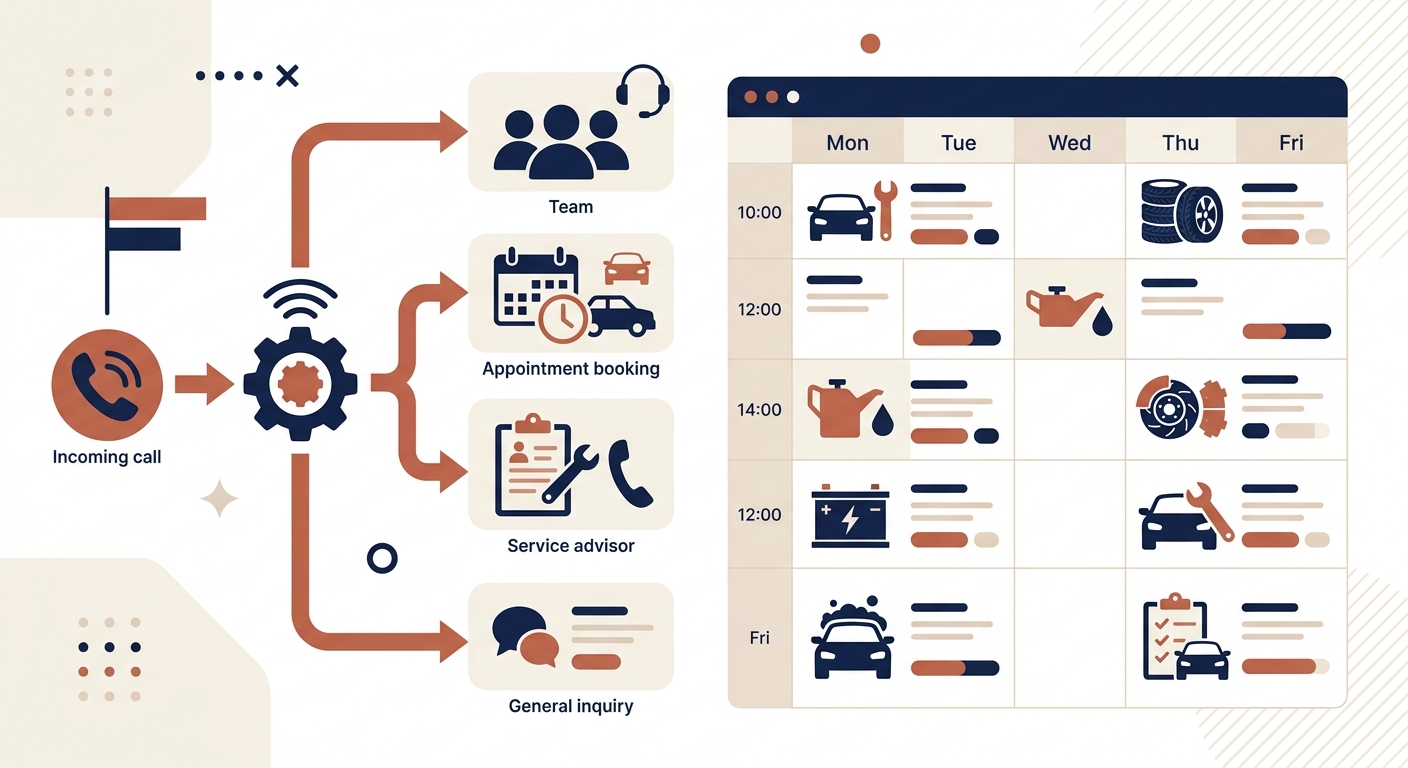
When a diagnostic car arrives in a 30-minute window, the options are turn the job away, run late across the board, or rush a diagnosis that should take 2 hours. The first costs the repair order. The second costs the customer relationship. The third costs the correct diagnosis — and often leads to a costly comeback. Qualifying call intent at intake eliminates all three.
Shops that qualify diagnostic calls at intake — before the car arrives — fill higher-value bays more consistently and close more additional-work authorizations.
05What "Is My Car Ready?" Really Costs You Per Day
The status call problem looks minor until you run the numbers.
A busy independent shop handles 30–50 inbound calls per day. At 30–35% status checks, that's 10–17 status calls daily. Each takes a service advisor 4–5 minutes: locate the vehicle in the system, confirm status, answer follow-up questions, wrap up. That's 50–85 minutes per day, per advisor, generating zero revenue.
At a median service advisor hourly cost of $25–$32 (per Bureau of Labor Statistics data), that's $21–$45 in labor per day, per advisor, consumed by status checks alone. Across two advisors over a year: $11,000–$23,000 in labor spent on calls that could be handled automatically.
But the real cost is what those advisors are *not* doing. An advisor at the counter closes more additional-work approvals, upsells fluid exchanges and filter replacements, and builds the trust that turns a first-time repair into a 10-year customer. Every status call they field is a floor conversation that didn't happen — and a retention moment that didn't land.
"Status calls are the tax your service advisors pay for being the only person who can find a repair order. AI removes the tax."
06Will Customers Trust an AI Answering My Shop's Phone?
This is the most common pushback from shop owners who've seen AI done badly — robotic phone trees, canned responses, zero ability to handle a real question. The concern is valid. Auto repair is one of the highest-trust service categories. Customers hand over a $25,000 vehicle and authorize work they can't always evaluate themselves.
The answer isn't about AI capability — it's about caller experience. A well-configured voice agent doesn't sound like a phone tree. It sounds like a competent, well-trained receptionist who knows your shop's hours, service menu, and can give an accurate status update without putting anyone on hold.
The filter effect actually strengthens the relationships that matter most. When your service advisors only take calls requiring their expertise — work approvals, complex diagnostics, disputes — every conversation they have is unhurried and focused. That quality of attention is what builds loyalty.
What the AI filters out aren't relationships worth winning in person. It's the queue of callers who need a 90-second status update, nothing more. Response time and communication quality are the top two factors in auto repair customer retention per ASA research — both improve when advisors aren't buried in the call queue.
07RevSquared AI vs. Other Auto Shop Receptionists
Most AI receptionists for auto shops do one thing: answer the phone and capture appointment requests. Once deployed, they don't improve unless you engage a support team or rebuild a prompt from scratch.
RevSquared AI works differently. Every call is analyzed by the AI Sales Manager, which surfaces patterns your team would never spot manually — services callers ask about that you don't promote, objections that repeat across calls, diagnostic intent signals being routed to quick-service slots. It delivers those insights in plain English so you can act immediately.
The other difference is speed of change. Most platforms require a support ticket to update how the AI handles a specific call type. With RevSquared, you type what you want — in under 30 seconds.
| Feature | RevSquared AI | AutoLeap AIR | AgentZap | AutoShopReceptionist |
|---|---|---|---|---|
| Plain-English behavior updates | Yes — instant | No | No | No |
| Self-improving from call data | Yes (AI Sales Manager) | No | Limited | No |
| Emergency call routing | Yes — configurable | No | No | No |
| Quick service vs. diagnostic flows | Yes — separate logic | No | No | No |
| Base monthly pricing | $147/mo + $0.25/min | $99/mo (200 calls; $0.75/call overage) | $109/mo | $599/mo + $995 setup |
| Voice cloning | Pro + Growth tiers | No | No | No |
| CRM integrations | GHL, HubSpot, Zapier, n8n | AutoLeap native only | Mitchell 1, Tekmetric | Basic |
| Multi-language support | Yes (1,000+ voices) | EN/ES/FR | Limited | Limited |
| Annual contract | No | No | No | No |
AutoLeap AIR is worth evaluating for shops already running AutoLeap's management software — the calendar sync is native and tight. But at $0.75/call overage, a shop handling 700 calls per month on the Growth plan pays $349/mo versus roughly $250 at RevSquared. And every behavior change requires a support contact rather than a plain-English update.
AI doesn't replace your service advisors' relationships with customers — it removes the call queue that prevents those relationships from being their best.
08Set Up in 5 Minutes — No Prompt Engineering
Setting up an AI receptionist should not require a developer. With RevSquared, you go from zero to live in under five minutes:
1. Create your agent at platform.revsquared.ai/agents/new 2. Describe your shop — services, hours, pricing ranges, booking process 3. Define call routing logic — quick service vs. diagnostic, emergency escalation, status handling 4. Choose a voice from 1,000+ options (or clone your own on Pro) 5. Connect your calendar — Google Calendar, Calendly, or Cal.com 6. Forward your shop number — your AI is live
No test scripts. No prompt templates. No 48-hour setup window. If you need to adjust how the AI handles a specific call type next week, type it in plain English. Same plain-English control used by plumbing companies and roofing contractors — just tuned to your intake logic and service menu.
"The shop that can tune its AI in 30 seconds will always outperform the one waiting on a support ticket to fix a routing mistake."
09Bottom Line
Auto repair shops don't have a missed-call problem. They have a service advisor attention problem — and a call qualification problem. The phone pulls your highest-value staff away from the floor for calls requiring no expertise, and when it doesn't, it misroutes the calls that do into the wrong scheduling slot.
An AI receptionist that absorbs status calls, qualifies emergency versus price-shopper versus diagnostic intake, and books the right car into the right bay slot isn't a convenience upgrade — it's a direct investment in floor productivity and repair order quality. Every status call the AI handles is five minutes your advisor spends at the counter. Every qualified diagnostic slot is a $400+ repair order that arrives pre-approved and time-allocated correctly.
RevSquared AI starts at $147/month. One properly-routed diagnostic appointment per week — the kind that currently gets squeezed into a 30-minute quick-service slot — pays for the platform. Start your 7-day free trial and have your AI receptionist live before the end of the day.
For a full comparison of AI answering service costs across platforms, see our guide to AI answering services for small businesses.
10Frequently Asked Questions
Can an AI receptionist distinguish between quick-service and diagnostic appointment requests?
Yes — through intent classification in the call flow. RevSquared AI is configured with your service categories: quick service (oil change, tire rotation, battery swap) versus diagnostic (grinding, fluid leak, warning light, loss of power). When callers describe symptoms, the agent routes to the appropriate slot type, asks the right intake questions, and books the correct time window — without service advisor involvement.
How does the AI handle the "my car broke down" emergency call?
RevSquared AI recognizes breakdown intent from phrases in the first 10 seconds — "won't start," "smoke," "tow truck," "check engine" — and switches to a priority flow. It confirms same-day availability, collects vehicle details, books the diagnostic slot, and sends your service advisor an immediate SMS with full call context. The advisor follows up proactively instead of reactively.
Can the AI pull vehicle repair status from my shop management software?
Yes, through CRM integrations or automation tools like Zapier and n8n. RevSquared AI connects to GHL, HubSpot, and 1,500+ apps via Zapier. If your shop management system exposes job data via webhook or API, the AI can retrieve live repair status and deliver it to callers directly — no human involvement required.
What happens when a caller needs to approve additional repair work?
The AI recognizes calls requiring a human decision — verbal authorization for additional repairs — and escalates to your service advisor or triggers an immediate SMS notification. Work approvals over a threshold you define get flagged for direct callback. No authorizations slip through.
Can I customize what the AI says for specific services or promotions?
Yes — in seconds. Using RevSquared's plain-English prompt adjuster, you describe what you want: "When callers ask about brake service, mention our free brake inspection and that we can usually schedule same-day." The agent updates immediately, no developer required.
Try RevSquared free for 7 days.
Set up your agent in under 5 minutes. Live on your existing number. No contract.