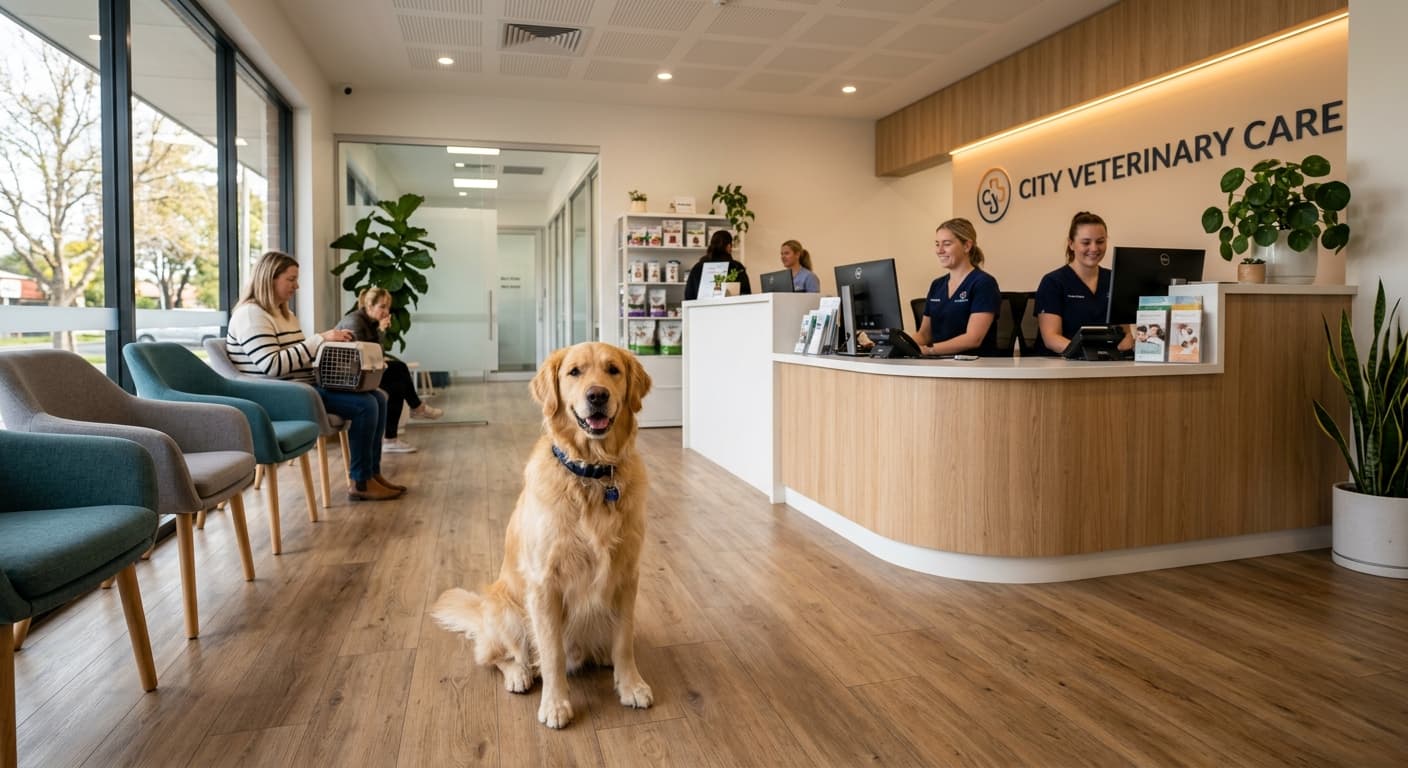
Your front desk is slammed. Two dogs are barking in the waiting room, a cat owner is checking out, and the phone is ringing for the fourth time in three minutes. Nobody can pick it up. On the other end of that call is a panicked pet owner whose Labrador just ate an entire bag of chocolate chips.
That call goes to voicemail. The pet owner hangs up and calls the clinic down the street instead.
This isn't a hypothetical. Studies show the average veterinary clinic fails to answer nearly 1 in 4 incoming calls — and during peak hours like Monday mornings and surgery blocks, that number climbs even higher. Worse, 85% of callers who reach voicemail won't call back. They'll call a competitor who picks up. At an average lifetime client value of $4,000–$10,000, every missed call is thousands of dollars walking out the door.
In veterinary medicine, the phone is a triage tool — an AI that answers every call and flags true emergencies is patient care, not just operations.
01The Veterinary Phone Problem Is Getting Worse
Here's what makes this especially painful for vet clinics: over 90% of appointments are still booked by phone. Not online. Not through an app. By calling. And the demand for veterinary services is surging — pet healthcare spending is projected to increase 33% over the next decade, requiring an estimated 41,000 additional veterinarians by 2030. Even with new graduates, the industry faces a 15,000-person shortage.
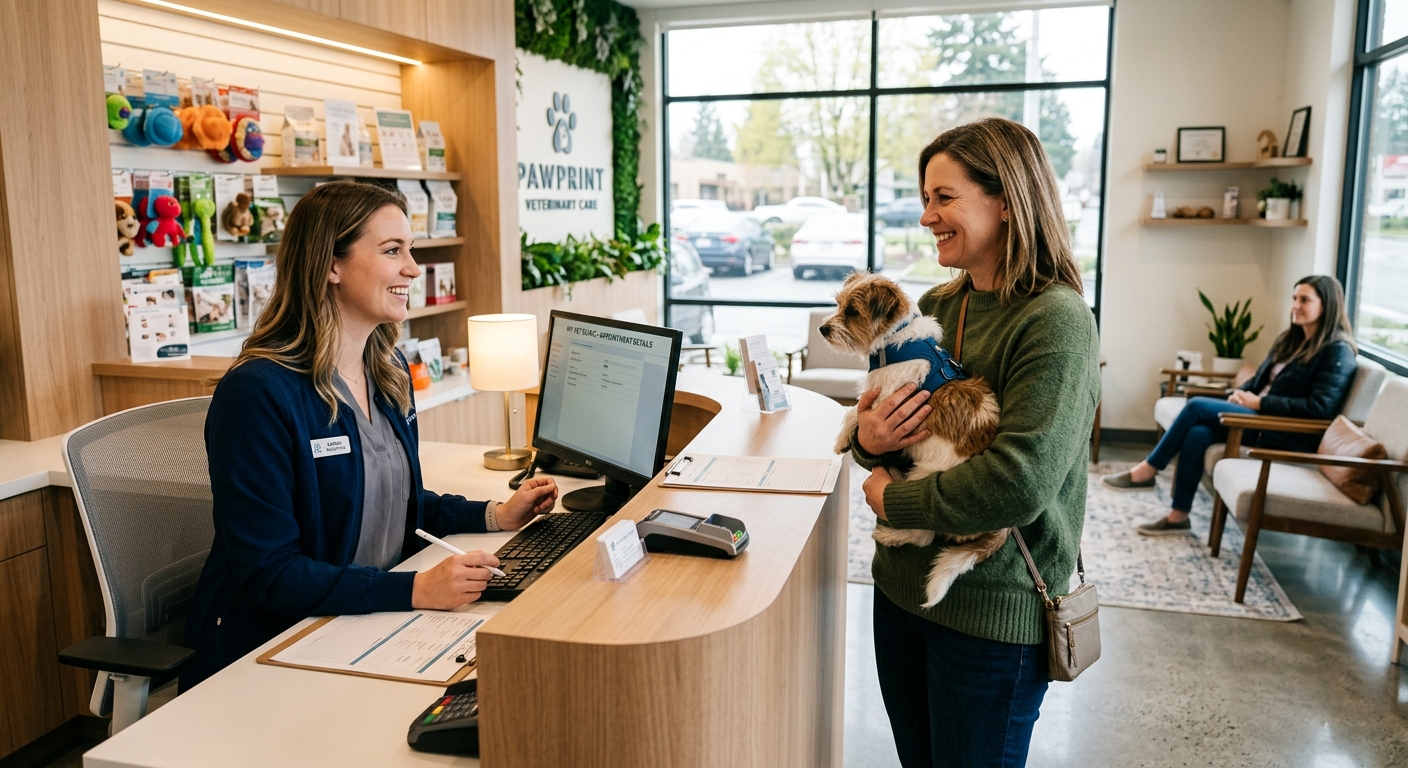
That means your existing team is handling more patients, more procedures, and more complexity — while the phone keeps ringing. The average small-animal practice front desk juggles answering calls, greeting walk-ins, processing payments, managing records, and assisting vets. Something has to give, and it's usually the phone.
Staff turnover compounds the problem. The average employee turnover rate in veterinary practices is about 23% per year, with receptionists and technicians citing phone management as one of the most stressful parts of the job. Average receptionist tenure is under 2 years, and total employment costs run $42,000–$52,000/year — covering only about 40 hours per week.
Hiring another receptionist sounds like the obvious fix. But finding qualified candidates in today's veterinary labor market is brutal, training takes months, and you still don't have coverage at 9 PM when that Labrador eats the chocolate.
02How AI Receptionists Work for Vet Clinics
An AI receptionist for your veterinary clinic answers every incoming call — first ring, every time, 24 hours a day. No hold music, no voicemail, no missed emergencies. The AI uses natural language processing to understand what the caller needs, holds a genuine conversation, and takes action.
Here's what happens when a pet owner calls your AI-equipped clinic:
1. Instant pickup — The call is answered immediately, even if it's 2 AM on a Sunday or your team is in back-to-back surgeries.
2. Natural conversation — The AI greets the caller warmly, asks what's going on, and listens. It doesn't sound like a phone tree. It sounds like a trained receptionist who knows your practice inside and out.
3. Smart triage — Based on the caller's description of symptoms, the AI can identify urgent situations (toxin ingestion, difficulty breathing, trauma) and escalate immediately — connecting to your on-call vet or emergency partner.
4. Appointment booking — For routine needs — wellness exams, vaccinations, dental cleanings, follow-ups — the AI checks your calendar availability and books the appointment on the spot. No callback needed.
5. FAQ handling — "What are your hours?" "Do you see exotic pets?" "How much is a spay?" The AI answers instantly from your knowledge base, freeing your team from repetitive questions.
6. CRM logging — Every call gets summarized and logged automatically. New client info, appointment details, symptoms discussed — it's all in your system before your team even knows the call happened.
If you're already familiar with how AI receptionists work in general, the veterinary application follows the same principles — but with clinic-specific customization that makes all the difference.
Your front desk can't see every caller's face, but the AI can hear the panic and route accordingly — that's triage you don't have to train.
03Emergency Triage: The Feature That Changes Everything
This is where AI receptionists deliver the most critical value for vet clinics. Pet emergencies don't follow a schedule. A dog gets into antifreeze at midnight. A cat stops eating on a holiday weekend. A puppy has a seizure during your lunch break.
With a traditional setup, after-hours emergencies either go to voicemail (dangerous), get routed to an expensive answering service (impersonal), or require your staff to be on-call 24/7 (burnout). None of these options are great.
An AI receptionist can be programmed with your specific emergency protocols:
- Symptom detection — The AI recognizes keywords and descriptions that indicate emergencies: difficulty breathing, bleeding, ingestion of toxins, collapse, severe vomiting, seizures
- Immediate escalation — True emergencies get connected to your on-call vet or transferred to your emergency partner clinic instantly
- Calm guidance — While routing the call, the AI can provide basic first-aid guidance ("Keep your dog calm and still, don't induce vomiting, we're connecting you to Dr. Martinez now")
- Non-emergency after-hours — For calls that aren't urgent, the AI books the earliest available appointment and sends a confirmation text
A panicked pet owner at midnight doesn't need a voicemail beep. They need a calm voice that already knows your emergency protocol.
04The Numbers: What This Means for Your Bottom Line
Let's do the math for a typical small-animal practice receiving 80–100 calls per day:
| Metric | Without AI | With AI Receptionist |
|---|---|---|
| Calls answered | ~75% | 100% |
| After-hours calls captured | ~10% (voicemail) | 100% |
| Average missed calls/day | 20–25 | 0 |
| Monthly missed revenue | $8,000–$25,000 | $0 |
| No-show rate | 15–20% | 8–12% (with AI reminders) |
| Staff phone time/day | 3–4 hours | <1 hour |
| Annual receptionist cost | $42,000–$52,000 | $1,188–$2,388 (Revenue Squared AI) |
Some of these numbers deserve unpacking:
Missed revenue recovery — If your clinic misses 20 calls per day and even 30% of those were potential appointments worth $150–$300 each, that's $900–$1,800 per day in lost revenue. Over a month, that's $18,000–$36,000. An AI receptionist capturing even half of those calls pays for itself many times over.
No-show reduction — AI-powered appointment reminders can reduce no-shows by up to 35%. For a practice losing $50,000+ per year to empty appointment slots, that's a massive recovery.
Staff efficiency — When your team isn't glued to the phone, they can focus on patient care, client experience in the clinic, and the work that actually requires a human touch. Multiple practice managers report that implementing AI phone handling decreased staff stress levels significantly and improved team morale.
The ROI case for voice AI is strong across all small businesses, but veterinary clinics see some of the highest returns because of the combination of high call volumes, time-sensitive emergencies, and limited staffing.
Missing three exam slots a day is $900 out the door — the AI pays for itself before lunch on day one.
05What About the Client Experience?
This is the question every vet clinic owner asks: "Will my clients — many of whom treat their pets like family — feel comfortable talking to an AI?"
The short answer: most callers won't even realize they're talking to AI. Today's voice AI is dramatically more natural than the robotic phone trees of the past. The AI uses your clinic's name, knows your veterinarians by name, understands your services, and speaks with natural cadence and warmth.
But the longer answer matters more: what clients hate is not being able to reach you at all. A pet owner whose cat is vomiting at 10 PM doesn't care whether they're talking to a human or an AI — they care about getting help. Right now. A warm, knowledgeable AI that answers on the first ring and provides actionable guidance will always beat a voicemail box that says "Our office is currently closed."
Veterinary clinics using AI receptionists consistently report:
- Higher client satisfaction scores — because every call is answered promptly
- More 5-star Google reviews — because the phone experience is seamless
- Better client retention — because clients feel taken care of, even after hours
- Fewer angry callbacks — because nobody had to leave a voicemail and wait
06Setting Up AI Reception for Your Vet Clinic
Here's the good news: you don't need to be technical to set this up. With Revenue Squared AI, the process takes about 5 minutes:
Step 1: Describe your practice — Enter your clinic name, services, hours, veterinarians, and any special protocols. The AI builds its knowledge base from this information.
Step 2: Set your emergency rules — Define what constitutes an emergency for your practice, who should be notified, and how urgent calls get routed.
Step 3: Connect your calendar — Link your appointment scheduling system so the AI can book in real time. Revenue Squared AI integrates with major veterinary practice management systems and CRMs.
Step 4: Customize the voice and personality — Choose a voice that fits your brand, or clone your own. Set the tone — friendly, professional, empathetic — whatever matches your practice.
Step 5: Forward your phones — Set up call forwarding so calls route to your AI receptionist when your team can't answer. Or set it as your primary line for 24/7 coverage.
That's it. No coding, no IT department, no six-month implementation. The AI learns and improves after every call, getting better at handling your specific client base over time.
For a detailed walkthrough, check our step-by-step setup guide.
Vet clients forgive a wait for the exam — they do not forgive a ringing phone when their dog is bleeding on the living-room floor.
07Why Revenue Squared AI Beats Veterinary-Specific AI Tools
You might be wondering: "Shouldn't I use an AI tool built specifically for veterinary clinics?"
Here's our honest take. Veterinary-specific AI tools like Dodo and Lupa are building interesting products. But they come with trade-offs:
Cost — Veterinary-specific platforms often charge premium prices because they're niche. Revenue Squared AI starts at $147/month with per-minute rates as low as $0.20/min — significantly less than most vet-specific solutions.
Flexibility — Vet-specific tools lock you into their ecosystem. Revenue Squared AI is fully customizable — you control the knowledge base, conversation flows, and integrations. If you also run a boarding or grooming operation alongside your clinic, the same AI handles all of it.
Self-learning AI — Most veterinary AI tools use static scripts. Revenue Squared AI's AI learns from every call, getting smarter about how your specific clients communicate, what questions they ask, and how to handle edge cases.
Voice cloning — Give your AI a warm, recognizable voice instead of a generic text-to-speech robot. Most vet-specific tools don't offer this.
Scale — Revenue Squared AI handles hundreds of calls per day and up to 20 concurrent calls. During Monday morning rushes or after a social media post goes viral, the AI scales effortlessly. No busy signals, ever.
No annual contracts — Try it, see results, stay because it works. Not because you're locked in.
Vet-specific AI vendors lock you into their roadmap — a general-purpose platform built for learning adapts to your protocols faster than theirs ever will.
08Real-World Impact: What Vet Clinics Are Seeing
The veterinary AI receptionist space is growing fast. Here's what the data shows across clinics implementing AI phone handling:
- Clinics receiving 80–120 calls/day that previously missed 20–30% are now capturing 100% of calls, translating directly to fewer lost appointments
- One industry estimate suggests roughly $1,800 in potential weekly revenue may disappear from missed calls alone at a single practice — that's over $93,000/year recovered by simply answering the phone
- Practices report a significant decrease in phone wait times, allowing the human team to focus more on in-clinic customer service
- Staff report lower stress levels and more time for daily clinical work
- Dodo, a veterinary AI receptionist, claims clinics on their platform see $60,000+ per year in additional revenue from recovered calls — validating that the opportunity cost of missed calls is enormous regardless of which solution you choose
09The Bottom Line
Your veterinary clinic exists to help animals and the people who love them. But you can't help anyone if they can't reach you. Every missed call is a pet owner who needed you and couldn't get through — and a client your competitor gained by simply picking up the phone.
An AI receptionist ensures that never happens. Every call answered. Every emergency triaged. Every routine appointment booked. Every FAQ handled. Every after-hours caller taken care of. All while your team focuses on what they went to vet school to do: practice medicine.
At $147/month — less than the cost of a single day of a full-time receptionist's salary — there's no reason any veterinary clinic should still be sending pet owners to voicemail.
Set up your AI receptionist in 5 minutes today.
Try RevSquared free for 7 days.
Set up your agent in under 5 minutes. Live on your existing number. No contract.