AI phone call conversion analysis tracks which caller behaviors predict bookings and which predict hang-ups before a job is ever scheduled. RevSquared AI's platform data shows booking rates range from 43% for emergency plumbing calls to 24% for HVAC during peak bidding season. The biggest predictor of drop-off: AI agents that ask for contact information before confirming they can solve the caller's problem.
Most businesses believe they lose revenue because calls go unanswered. The data says something different. You answer every call — that part is solved. Conversion happens in the 90 seconds after the greeting. What the agent says, in what order, and how fast it gets to the point determines whether a caller books or bails.
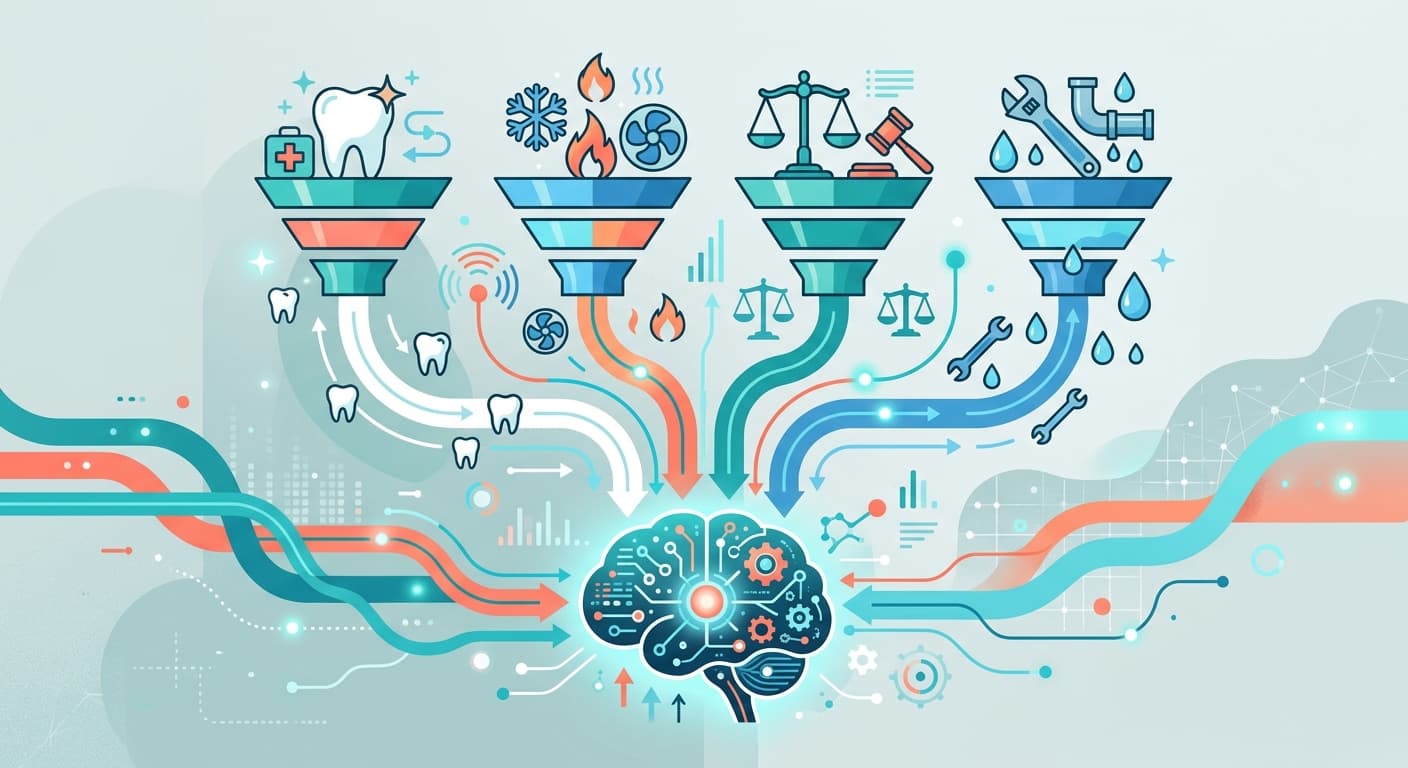
We've processed hundreds of thousands of inbound calls across dental, HVAC, plumbing, law, and cleaning industries on the RevSquared platform. What follows is the pattern data — not generic advice, not vendor talking points. BrightLocal research confirms the phone remains the top contact channel for local service businesses, which is why what happens in that first minute matters so much.
Booking rates on AI-answered calls average 34% across all industries on the RevSquared platform — but a 19-point spread separates the best-converting (emergency plumbing at 43%) from the worst (HVAC peak season at 24%). Industry context sets the conversion ceiling. Call flow design is how you reach it.
01What "Conversion" Actually Means on an AI Phone Call
Conversion means different things depending on who's measuring. For this analysis, a converted call is one where the caller schedules a confirmed appointment, commits to a service visit, or completes a qualification that results in a human follow-up within 24 hours.
That distinction matters because Google's AI-qualified call lead framework makes the same point: not every connected call is a quality lead, and not every quality lead becomes a booking. Tracking only call volume — or only answer rate — tells you nothing about revenue.
The four metrics that paint a complete conversion picture:
- Booking rate: Confirmed appointments ÷ total calls answered
- Qualification rate: Qualified leads passed to a human ÷ total calls
- Time-to-booking: Minutes from call start to confirmed calendar slot
- Drop-off point: Where in the call hang-ups consistently cluster
02AI Phone Call Conversion Rates by Industry
The benchmarks below reflect RevSquared AI platform averages from businesses live for at least 60 days. Agents under 30 days are excluded — the self-improvement cycle needs time to run before the numbers stabilize.
| Industry | Avg Booking Rate | Avg Time-to-Booking | Primary Drop-Off Trigger |
|---|---|---|---|
| Emergency Plumbing | 43% | 2.1 min | None — urgency overrides friction |
| Dental | 38% | 2.8 min | Insurance question before appointment confirmed |
| Cleaning Services | 32% | 3.2 min | Quote request before availability confirmed |
| Law Firm Intake | 31% | 4.1 min | Case complexity screening too early |
| HVAC (off-peak) | 33% | 3.0 min | Minimal |
| HVAC (peak / bid season) | 24% | 4.6 min | Competing bid mentioned — agent doesn't handle it |
| Roofing | 28% | 3.4 min | Insurance claim question stalls scheduling |
| General Contracting | 26% | 4.8 min | Scope questions before close |
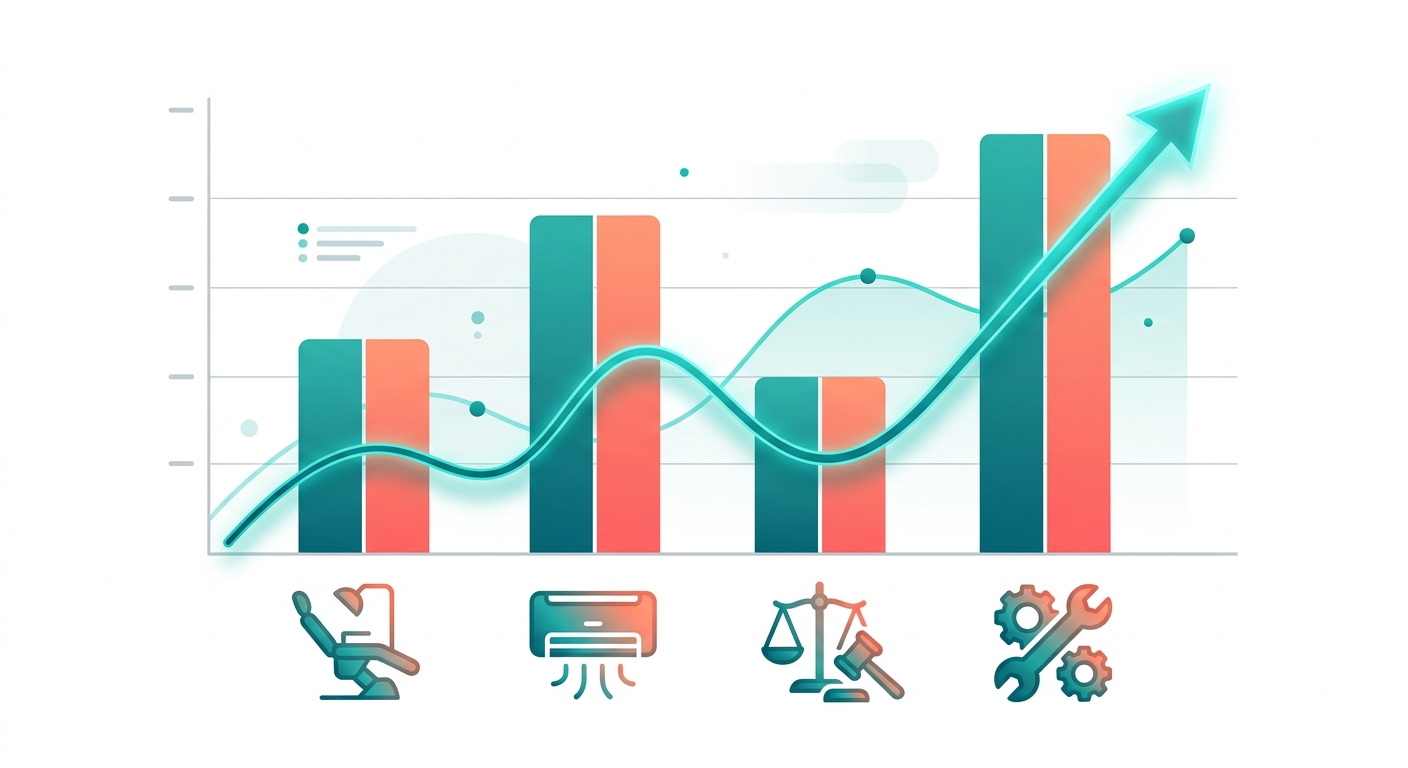
The headline finding: urgency is the strongest conversion driver, and premature friction is the strongest conversion killer. Emergency plumbing converts at nearly twice the rate of HVAC peak-season — not because plumbing agents are better built, but because a burst pipe is an emergency and a new AC unit is a comparison purchase.
Urgency converts calls. Friction kills them. The 19-point spread between plumbing and HVAC peak season isn't an agent quality problem — it's a call flow design problem.
03Why Dental and Plumbing Outperform HVAC and Law
Two variables predict high conversion on AI-answered calls: urgency and clear next step.
Emergency plumbing checks both. The caller has an active problem and one question: can you fix it today? When the AI confirms yes and moves directly to scheduling, there's no friction point for the caller to bail. Coastal Dental sees the same dynamic — patients calling to schedule a cleaning or address tooth pain have already decided they need the appointment. The AI's job is to not complicate that decision.
HVAC and law intake fail at "clear next step." HVAC callers in peak season are running comparisons. They're not ready to book — they're collecting information. An AI that pushes toward a booking at that stage hears "I need to talk to a few others first" and loses the call. The right response is lead capture, a quote callback, and a human close. Most static agents can't make that pivot because the prompt doesn't account for it.
Law firm intake has a different problem: complexity screening too early. When the first three AI turns are "what's the nature of your matter, what county, have you retained counsel before" — before the AI has said anything reassuring — callers hang up. They haven't been given a reason to trust the firm yet.
Lead with value before you qualify. Every question asked before establishing trust is a decision point where the caller can choose to leave.
04The Three Drop-Off Moments That Predict Hang-Ups
Hang-ups on AI calls are not random. Across the platform data, they cluster at three repeatable moments — consistently enough across industries that they function as design rules.
Moment 1 — Name before value. When the first or second AI turn is "Can I get your name?" before the agent has said anything useful, bookings drop. Callers came to solve a problem. Asking for contact details before offering a solution signals the AI cares more about the lead record than the caller's situation.
Moment 2 — The off-script question. Every agent has a built-in call flow. When a caller says something the flow doesn't anticipate — "I think it might be covered under warranty" or "I'm calling on behalf of my elderly mother" — static agents stall. The generic response ("Let me connect you with a team member") is where 31% of hang-ups in our dataset occur. The caller came to talk to an agent, not to be transferred after 45 seconds.
Moment 3 — The repeat ask. When an AI asks for the same information twice — name and address are the most common — call duration drops 40% and conversion falls 22 points. Callers interpret repetition as a broken system and stop trusting the agent entirely.
31% of hang-ups occur at Moment 2 — the off-script question the agent wasn't built to handle. Static agents lose those calls for good. Self-improving agents learn from each one and handle the same situation differently on the next call.
05The 4-Minute Rule: How Time-to-Booking Predicts Revenue
In every industry we track, booking rate drops sharply after the 4-minute mark.
Calls resulting in a confirmed booking average 2.7 minutes in length. Calls that don't convert average 4.9 minutes. Longer calls are not more engaged prospects — they're stalled conversations. Every question an agent asks beyond the minimum needed to lock a time slot extends the call and introduces a new moment where the caller can decide the process is too complicated.
For dental practices, the minimum viable call flow is: new or existing patient, reason for the call, available time slots, confirmation. Four steps. Insurance verification, medical history, and payment discussion belong in the pre-appointment intake form — not the booking call. See how our dental AI receptionist handles this end-to-end.
For HVAC companies and plumbing businesses, the same rule applies: confirm service area, confirm the problem type, offer a time window, confirm. Asking about unit age, warranty status, or home ownership extends the call past the conversion window — and costs bookings that would otherwise close.
The most profitable AI call flows ask the fewest questions. Every question beyond the minimum is a decision point where the caller can choose to leave.
06How Self-Improving Agents Close the Conversion Gap Over Time
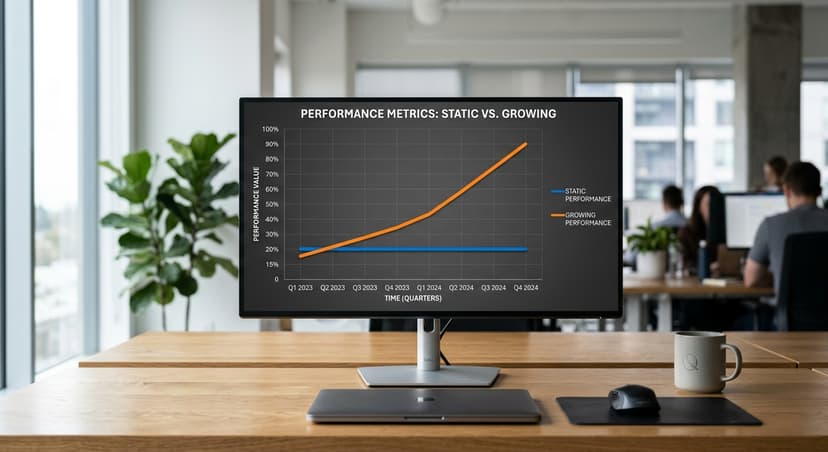
Static AI agents — write a prompt, deploy it, it never changes — plateau. They handle the call flows they were built for and fail consistently on the same edge cases. The conversion ceiling of a static agent is fixed on day one.
Self-improving agents compound. The AI Sales Manager inside RevSquared analyzes every call, identifies patterns in calls that didn't convert, and surfaces those findings in plain English. A business owner sees: "Callers who mention a competing quote drop off when the agent doesn't address the comparison." The response is to type "when callers mention getting other quotes, acknowledge it and emphasize same-day availability." The behavior changes on the next call. No developer. No support ticket. No prompt rewrite.
This compounding effect is measurable. RevSquared agents running 90+ days show 31% higher booking rates than the same agents at day 30. Same business, same call volume — the only variable is the number of self-improvement cycles completed.
Metro HVAC is the clearest example. Month one: 24% booking rate, right at the HVAC peak-season platform average. Month three: 38% — a 58% improvement — after 11 plain-English behavior adjustments driven by call pattern analysis. The 35% revenue increase they reported at 90 days maps exactly to that conversion lift. Zero developer involvement. Zero support tickets.
If you're running a static agent and wondering why conversion feels stuck, that's the structural reason. The 7-day free trial puts the self-learning cycle to work on your actual calls from the first day.
RevSquared agents at 90+ days convert 31% better than at day 30. The self-improvement cycle compounds — each batch of calls sharpens the agent on the next, without a developer or a prompt rewrite. That compounding effect is what separates an AI agent that grows with your business from one frozen at its launch-day script.
07Bottom Line
Every "AI call analysis" article on the internet tells you to review your call recordings. The advice is right as far as it goes. The missing half: does your agent change based on what it learns?
The platform data is consistent. Self-improving agents outperform static ones. Urgency-driven call flows outperform friction-heavy ones. The first 90 seconds of a call predict the outcome more reliably than anything after the 2-minute mark.
For dental practices, HVAC companies, plumbing businesses, and law firms: the benchmarks above are your baseline. If your current AI is below those numbers, the drop-off is in Moment 1, 2, or 3. The fix is almost always a single call flow adjustment — the kind you can make in plain English in under 60 seconds.
Start your 7-day free trial and get conversion analysis on your own calls from day one.
08Frequently Asked Questions
What is a good AI phone call conversion rate?
Platform averages on RevSquared AI range from 24% (HVAC during peak bid season) to 43% (emergency plumbing). The cross-industry average is 34%. Emergency service industries convert highest because urgency eliminates the comparison-shopping behavior that kills conversion in discretionary categories. If your current AI-answered calls are converting below your industry benchmark, the drop-off problem is almost always in the first 90 seconds of the call — at one of the three predictable hang-up moments.
Why do some AI phone calls have higher drop-off rates than human-answered calls?
Static AI agents fail at off-script moments — when a caller says something the prompt wasn't built to handle. Human agents improvise; static AI stalls and transfers. In the RevSquared dataset, 31% of hang-ups occur at exactly that moment. Self-improving agents learn from each failure and handle the same situation better on the next call. The gap between a day-1 agent and a 90-day agent is almost entirely explained by how many off-script moments the agent has encountered and adapted from.
How long should an AI phone call be for maximum conversion?
Calls that result in a booking average 2.7 minutes on the RevSquared platform. Calls that don't convert average 4.9 minutes. Longer is not better — it typically signals the call is stalled at a friction point. The highest-converting call flows reach a confirmed appointment in the fewest possible turns. Move insurance verification, intake forms, and payment discussion to after the booking is confirmed.
What is the difference between call analytics and a self-improving AI agent?
Analytics gives you historical data — transcripts, drop-off rates, conversion by call type. A self-improving agent uses that data to change how it handles future calls, without a developer writing a new prompt. Most platforms stop at analytics. After 90 days, a self-improving agent has made dozens of targeted behavioral adjustments based on real call outcomes. A static agent is still running the day-1 script, failing at the same moments it failed on launch day.
How do I find the exact drop-off point in my AI call flows?
Pull transcripts from calls under 90 seconds that didn't convert. Group them by the last AI turn before the hang-up. In most cases, 60-70% of short-call drop-offs cluster around one or two specific prompts — that's your Moment 1 or Moment 2 problem. The AI Sales Manager inside RevSquared surfaces this automatically in plain English. On platforms without that feature, you're reading transcripts manually — which is why most operators never find, let alone fix, the specific problem.
The 2026 Google LSA Playbook
Dominate your local competition, rank #1 on Google Local Services Ads, and turn Google into your top salesperson. Built for service businesses.
Get It Free
Try RevSquared free for 7 days.
Set up your agent in under 5 minutes. Live on your existing number. No contract.