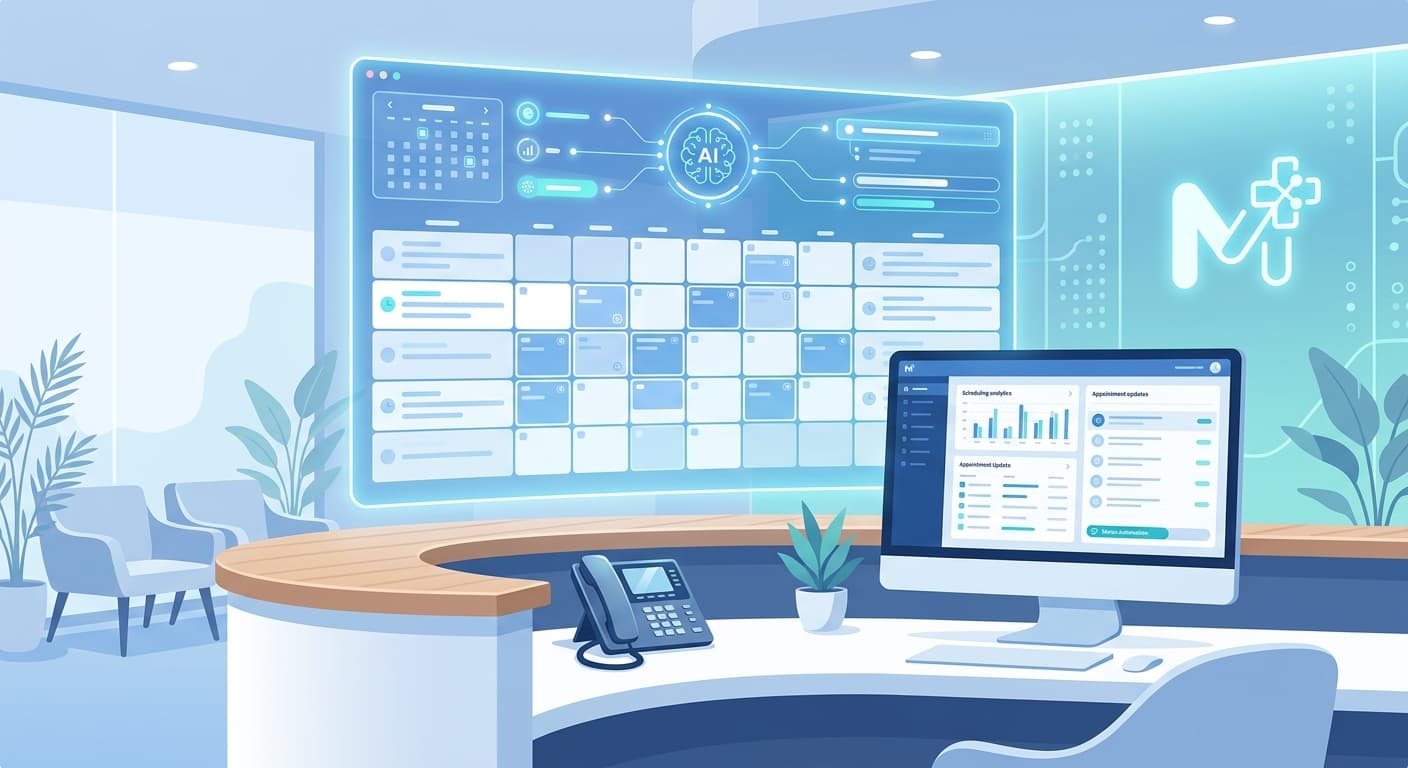
An AI receptionist for medical practices is a voice agent that answers patient calls 24/7, qualifies callers using practice-specific triage logic, and routes them to scheduling without touching your EHR. RevSquared AI costs $147/mo plus $0.25/min, sets up in under five minutes, and lets any staff member update call-handling behavior in plain English — no prompt engineering, no dev tickets.
Medical practices lose patients not because they deliver poor care, but because 42% of inbound calls go unanswered. After-hours callers don't leave messages and wait until morning — they go to urgent care, book at a competitor practice, or simply don't follow through. This guide covers how RevSquared AI closes that gap using call flows, lead qualification, and CRM handoffs you control without writing a single line of code.
At $200 per missed appointment, a practice missing just 10 calls per week is leaving roughly $8,000 in recoverable revenue on the table every month — before accounting for patient lifetime value.
01Why Medical Practices Miss 42% of Patient Calls
Medical front desks handle check-ins, insurance verification, prescription refills, and provider queries — all simultaneously. Inbound scheduling calls are the lowest priority when a patient is standing at the counter. The result: call abandonment rates of 42% or higher, documented across primary care and specialty practices, according to OHMD's virtual receptionist research.
The capacity math makes the problem structural, not behavioral. The Bureau of Labor Statistics shows the average medical receptionist handles 75–100 calls per day. Any practice receiving more than 80 inbound calls daily is already at physical capacity during peak hours — meaning callers routinely hit busy signals, hold times, or voicemail during the window they're most motivated to schedule.
What makes this worse is that most missed calls don't require a human. 63% of incoming patient calls are routine: appointment scheduling, directions, hours confirmation, prescription refill requests. An AI agent handles all of those in under 90 seconds — freeing your front desk staff for the calls that actually need clinical judgment.
The 42% of calls that go unanswered in a medical practice aren't random — they're concentrated during peak hours and after closing, exactly when patients are most motivated to book.
02The After-Hours Scheduling Gap
The average medical practice operates 8 AM to 5 PM, Monday through Friday. That's 45 hours per week. The remaining 123 hours — evenings, weekends, holidays — are when working adults have time to deal with healthcare logistics. A patient who needs a primary care visit isn't calling at 10 AM on a Tuesday. They're calling at 7 PM or Saturday morning.
When those calls hit voicemail, patients don't wait until morning. They make a decision in under 30 seconds: book through an urgent care app, find a competitor practice on a scheduling platform, or put the visit off until the problem gets worse. The practice never knows the call happened — no voicemail played, no CRM entry created, no missed-call record.
This is the scheduling gap. A practice with 20 after-hours calls per week and a 60% booking conversion rate is leaving 8 new patient visits per week uncaptured. At $150 average visit revenue, that's $62,400 per year in recoverable revenue from calls that happened and were never answered. The ROI math on voice AI for small businesses is just as stark in healthcare as in any other service sector.

03How RevSquared Handles Medical Call Triage in Plain English
Most AI phone tools give you a static script. A caller asks something outside the script, and the agent fails. RevSquared works differently: you describe call-handling logic the way you'd brief a new staff member, and the agent adapts immediately. No prompt engineering. No dev tickets. No 24-hour wait for changes to go live.
Here's what that looks like for a medical practice. You type: "If a caller mentions chest pain, difficulty breathing, or says it's an emergency, immediately tell them to call 911 and provide our on-call line." Live in seconds. Or: "Dr. Chen is on leave through Friday — don't schedule new patients for her until next week." Done. Or: "Ask all new patients whether they have insurance before offering appointment times." Done.
That adaptability is what makes RevSquared specifically valuable in healthcare. Medical call flows change constantly — provider availability, seasonal surges, insurance changes, new services added or removed. Every other AI receptionist requires a support ticket or a developer to update the call logic. RevSquared's prompt adjuster lets any front desk staff member make that change in real time, from a plain interface.
The triage logic RevSquared handles for medical practices includes:
- Routine appointment scheduling for new and existing patients
- Practice hours, location, and provider availability questions
- Prescription refill request capture, routed to your clinical team
- Urgent symptom flags with configurable escalation instructions
- Insurance pre-screening and referral capture
- Callback scheduling for calls that require a live person
Medical call flows change weekly — provider schedules, insurance rules, seasonal demand. RevSquared is the only AI voice agent where a front desk staff member can update triage logic in plain English, without a developer or a support ticket.
04Appointment Scheduling and CRM Handoff
RevSquared integrates directly with Google Calendar, Calendly, and Cal.com for real-time appointment booking. A patient calls at 9 PM, asks to schedule a new patient visit, and gets booked into an open slot — without anyone from your practice being involved. The appointment lands in your calendar and the patient receives confirmation immediately.
For practices using GoHighLevel or HubSpot, the integration goes further. Lead data from every call flows into your CRM automatically: caller name, phone number, appointment type requested, and any triage flags captured during the conversation. Your front desk staff walks in Monday morning with a structured record of every weekend call — not a voicemail inbox, but organized data ready to act on. See the full list of RevSquared integrations.
The AI Sales Manager analyzes call patterns over time. If a specific routing path is causing callers to hang up, or if a particular call type is generating high no-show rates, it surfaces the issue and recommends a change. Practices see exactly where their call flow is leaking — and can fix it in one sentence. This is the self-improving layer that separates RevSquared from static competitors.
When a patient calls your practice at 9 PM and a real voice answers, books their appointment, and sends a confirmation — they don't switch providers. They become a long-term patient.
05AI Receptionist vs. Front Desk Staff: The Real Cost Comparison
| Human Receptionist | RevSquared AI | |
|---|---|---|
| Monthly cost | $2,800–$4,200 | $147–$497/mo + $0.25/min |
| Hours covered | ~45/week | 168/week |
| Concurrent calls | 1 | Unlimited |
| After-hours coverage | No | Yes |
| Sick days and turnover | Yes | No |
| Triage rule updates | Training required | Plain English, instant |
| Calendar booking | Manual | Automatic |
| CRM handoff | Manual entry | Automatic |
| Annual contract | Yes (typical) | No |
A full-time medical receptionist costs $34,000–$50,000 in base salary plus 20–25% in benefits and payroll taxes — $40,800 to $62,500 per year for 45 hours per week of coverage. After-hours calls still go to voicemail. Turnover in medical administrative roles runs about 19% per year, meaning recruiting and training costs recur roughly every five years.
RevSquared AI on the Starter plan ($147/mo + $0.25/min) handles unlimited concurrent calls around the clock. For a practice receiving 400 minutes of inbound call time per month, total cost is $247/mo — $2,964/year. For 800 minutes, $347/mo — $4,164/year. That's a savings of $36,000–$58,000 per year before factoring in recruitment, onboarding, and turnover costs.
Most practices don't replace their entire front desk with AI. They deploy RevSquared for after-hours and overflow — the 60%+ of weekly hours when no staff is on the phone. That coverage gap, closed for under $300/month, is where the ROI is hardest to argue against. For the full cost breakdown, see our after-hours call coverage analysis.
Most practices aren't replacing their front desk with AI. They're covering the 123 hours per week when no one is staffed — evenings, weekends, and the minutes when front desk staff are with patients at the counter.
06Setting Up Your Medical Practice AI Agent in Under 5 Minutes
Setup on RevSquared takes less time than writing the onboarding checklist for a new hire. Go to platform.revsquared.ai/agents/new, create a new agent, and describe your practice in plain English: name, address, hours, providers, services, and how to handle the main call types. The agent is live immediately.
From there, your team refines the agent as real calls happen. When a call surfaces a triage scenario you didn't anticipate, add one instruction. "Don't offer next-day slots on Mondays — those fill up by Tuesday." Done. This real-time adaptability is what practices with rotating providers and constantly shifting schedules find most valuable: the system adjusts to your operational reality, not to how things looked during setup months ago.
The Starter plan ($147/mo + $0.25/min) covers one inbound agent with Google Calendar scheduling — the right starting point for most single-location practices. The Pro plan ($497/mo + $0.20/min) adds multi-location support, voice cloning, CRM integrations, and the AI Sales Manager for higher-complexity operations. See full pricing. No annual contracts.
RevSquared is live in under 5 minutes and updates in real time. The medical practices that get the most from it aren't the most tech-forward — they're the ones that update their agent after every call that surprises them.
07Frequently Asked Questions
Is RevSquared HIPAA compliant?
RevSquared is a call-handling and scheduling layer — it captures caller contact information, appointment preferences, and triage routing data. It does not store or process protected health information inside the platform. Patient medical data lives in your EHR, which is where it belongs. Practices should review their specific workflows with legal counsel before routing any PHI through third-party software.
Can RevSquared handle after-hours calls for a medical practice?
Yes. RevSquared operates 24/7/365 with no difference in call quality between business hours and after-hours. You configure after-hours behavior in plain English: which call types get booked, which get a callback scheduled, and which trigger an escalation to an on-call line. For more on the cost case, see our after-hours phone coverage guide.
What happens when a patient describes a medical emergency?
You define that logic during setup. For example: "If a caller mentions chest pain, difficulty breathing, severe bleeding, or says it's an emergency, immediately direct them to call 911 and provide the on-call number." RevSquared follows those instructions on every call without exception — 2 AM on a Sunday the same as 10 AM on a Tuesday.
Does RevSquared work for multi-location medical practices?
Yes. The Pro plan ($497/mo + $0.20/min) supports up to 3 inbound agents. Each location gets its own call logic, provider availability, and routing rules, all managed from one dashboard. The Growth plan handles additional locations and adds outbound follow-up capability. See the medical industry page for a full feature breakdown.
How does RevSquared compare to a traditional medical answering service?
Traditional answering services charge $200–$600/month for after-hours coverage using human operators reading from a script. They don't book appointments, don't sync to your CRM, and require a support request to update their script. RevSquared books appointments in real time, integrates with your calendar and CRM, and updates call logic in plain English. For how the same approach works in adjacent healthcare settings, see our dental office AI receptionist guide.
The 2026 Google LSA Playbook
Dominate your local competition, rank #1 on Google Local Services Ads, and turn Google into your top salesperson. Built for medical practices.
Get It Free
Try RevSquared free for 7 days.
Set up your agent in under 5 minutes. Live on your existing number. No contract.