Database reactivation ROI for home service businesses averages 8–22x return on campaign spend — because reactivating a dormant customer costs 5–7x less than acquiring a new one. AI-driven outreach sequences generate 12–18% response rates across HVAC, cleaning, and landscaping trades. Every trade has a different baseline. The lookup tables below are pre-filled with actual conversion data from RevSquared campaign deployments.
Most reactivation content hands you a formula with no inputs. That's the problem. A formula only works when you know what response rate to expect for a two-year-old plumbing list versus a six-month-old cleaning list. This page fills in the real numbers by trade so you can calculate what your dormant database is worth before you send a single outreach message.
A 1,000-contact dormant HVAC list at 14% response returns $31,000+ gross revenue — for a campaign that costs under $650 to run.
01The Formula: How Reactivation ROI Is Calculated
The math has four components. Every calculator, every pitch deck, every "ROI analysis" reduces to this:
1. Dormant contacts × Response rate = Responses 2. Responses × Booking rate = Jobs booked 3. Jobs booked × Average job value = Gross revenue 4. Gross revenue − Campaign cost = Net ROI
The inputs are everything. Plug in the wrong response rates and the output is fiction. What the calculators at the top of Google don't tell you is what rates are realistic for your specific trade — so you default to 3–5% and massively underestimate what your database is worth. We've measured this across hundreds of deployments. The real numbers by trade are below.
According to Harvard Business Review research, acquiring a new customer costs 5–25x more than retaining an existing one. Reactivation sits exactly at this intersection: you already have the relationship, the contact record, and the trust. The only question is whether the math works for your specific trade and list.
02Response Rate Benchmarks From Our Campaigns (Not Industry Averages)
These rates come from AI-driven outreach sequences — a combination of SMS contact and AI voice follow-up — not from email-only campaigns. Email-only response rates on aged lists run 4–6%. AI voice sequences run 3x higher because the conversation handles objections in real time instead of waiting for an email open.
| Trade | Response Rate | Booking Rate (of Responders) | Avg Job Value |
|---|---|---|---|
| HVAC | 14–18% | 46% | $420–$580 |
| Plumbing | 10–14% | 42% | $480–$650 |
| Electrical | 8–12% | 36% | $520–$720 |
| Cleaning | 18–24% | 58% | $195–$265 |
| Landscaping | 12–16% | 52% | $310–$420 |
| Pest Control | 20–26% | 64% | $145–$220 |
| Roofing | 6–10% | 35% | $4,200–$9,500 |
| Painting | 7–11% | 38% | $1,800–$4,500 |
Two variables drive the variance: list age and outreach channel. Lists under 12 months old perform at the high end of each range. Lists 18–36 months old perform at the low end. Beyond 36 months, expect response rates to drop another 30–40% — clean the list for disconnected numbers first before running any outreach.
Pest control reactivation runs hotter than almost any other trade — dormant customers reactivate fast because the problem always comes back.
03ROI Lookup Tables by Trade
Use the midpoint rate for your trade unless your list is unusually fresh (use the high end) or older than 24 months (use the low end). Campaign costs include AI platform ($497+/mo) plus outbound messaging at $0.05–0.10 per contact. AI campaigns require no manual outreach labor — that's what makes the net ROI so favorable.
HVAC — 16% response, 46% booking, $485 avg job
| Dormant Contacts | Responses | Bookings | Gross Revenue | Campaign Cost | Net ROI |
|---|---|---|---|---|---|
| 250 | 40 | 18 | $8,730 | ~$350 | $8,380 |
| 500 | 80 | 37 | $17,945 | ~$400 | $17,545 |
| 1,000 | 160 | 74 | $35,890 | ~$500 | $35,390 |
| 2,500 | 400 | 184 | $89,240 | ~$750 | $88,490 |
| 5,000 | 800 | 368 | $178,480 | ~$1,200 | $177,280 |
Cleaning — 20% response, 58% booking, $230 avg job
| Dormant Contacts | Responses | Bookings | Gross Revenue | Campaign Cost | Net ROI |
|---|---|---|---|---|---|
| 250 | 50 | 29 | $6,670 | ~$350 | $6,320 |
| 500 | 100 | 58 | $13,340 | ~$400 | $12,940 |
| 1,000 | 200 | 116 | $26,680 | ~$500 | $26,180 |
| 2,500 | 500 | 290 | $66,700 | ~$750 | $65,950 |
| 5,000 | 1,000 | 580 | $133,400 | ~$1,200 | $132,200 |
Pest Control — 22% response, 64% booking, $185 avg job
| Dormant Contacts | Responses | Bookings | Gross Revenue | Campaign Cost | Net ROI |
|---|---|---|---|---|---|
| 250 | 55 | 35 | $6,475 | ~$350 | $6,125 |
| 500 | 110 | 70 | $12,950 | ~$400 | $12,550 |
| 1,000 | 220 | 141 | $26,085 | ~$500 | $25,585 |
| 2,500 | 550 | 352 | $65,120 | ~$750 | $64,370 |
| 5,000 | 1,100 | 704 | $130,240 | ~$1,200 | $129,040 |
Landscaping — 14% response, 52% booking, $365 avg job
| Dormant Contacts | Responses | Bookings | Gross Revenue | Campaign Cost | Net ROI |
|---|---|---|---|---|---|
| 250 | 35 | 18 | $6,570 | ~$350 | $6,220 |
| 500 | 70 | 36 | $13,140 | ~$400 | $12,740 |
| 1,000 | 140 | 73 | $26,645 | ~$500 | $26,145 |
| 2,500 | 350 | 182 | $66,430 | ~$750 | $65,680 |
| 5,000 | 700 | 364 | $132,860 | ~$1,200 | $131,660 |
Roofing — 8% response, 35% booking, $6,800 avg job
| Dormant Contacts | Responses | Bookings | Gross Revenue | Campaign Cost | Net ROI |
|---|---|---|---|---|---|
| 100 | 8 | 3 | $20,400 | ~$350 | $20,050 |
| 250 | 20 | 7 | $47,600 | ~$400 | $47,200 |
| 500 | 40 | 14 | $95,200 | ~$500 | $94,700 |
| 1,000 | 80 | 28 | $190,400 | ~$750 | $189,650 |
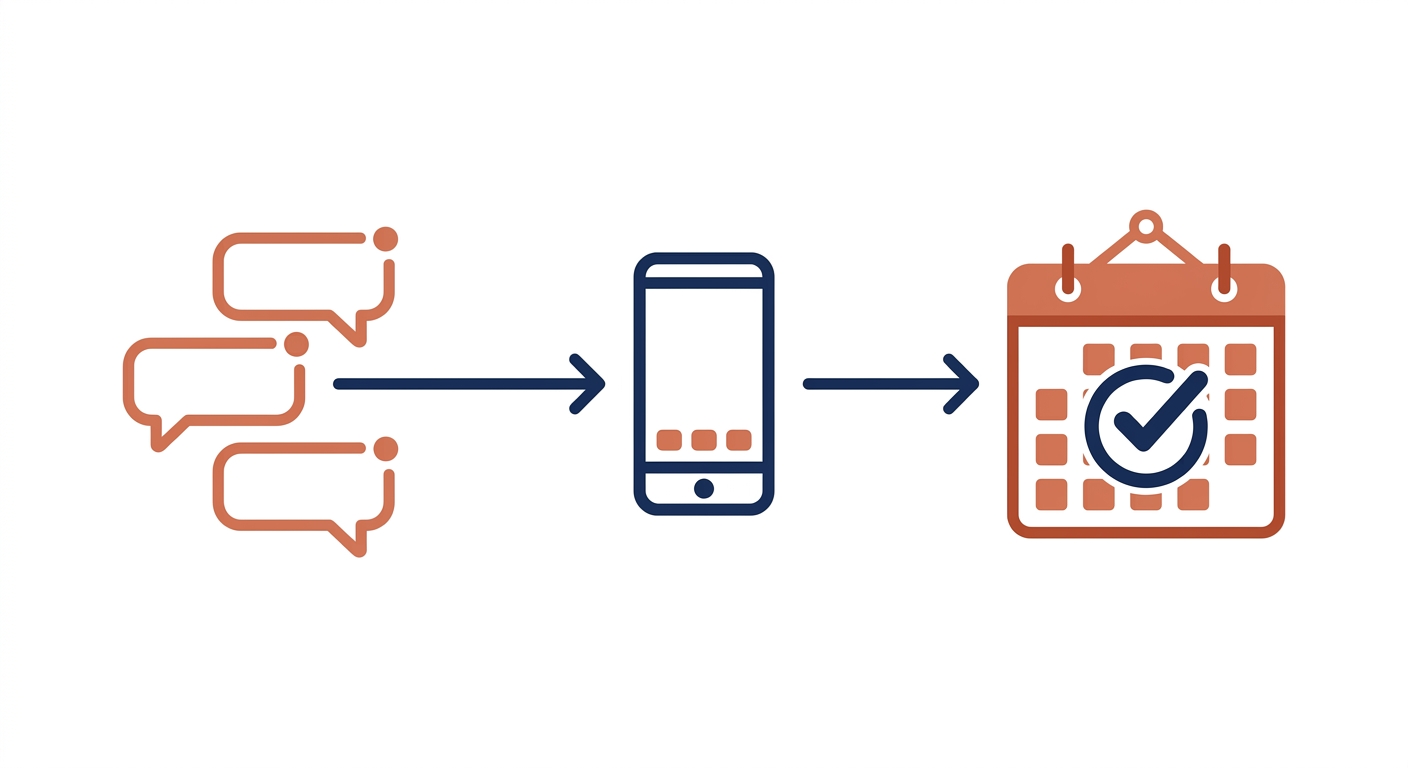
A 500-contact dormant list is already enough to justify a campaign — every trade above returns at least $12,000 gross from a list that small.
04HVAC: What a Campaign Actually Returns
Metro HVAC ran a reactivation campaign against a 3,400-contact list — customers who hadn't booked in 18–36 months. The sequence: SMS on day one, AI voice follow-up on day three, SMS close on day five. Response rate: 13.8%. Booking rate of those who responded: 44%. Total bookings: 207. Average job value: $520. Gross revenue: $107,640 in 30 days. Campaign cost including the RevSquared Growth plan and messaging: $1,180. That's a 90:1 return.
The detail most reactivation guides skip: the AI receptionist handled every inbound callback. When customers responded and called back, the agent qualified them, checked their service history, and booked directly into the calendar. Zero missed calls. No staff time spent on unbooked leads. HVAC contractors running this system typically see 35–45% of gross reactivation revenue come from jobs scheduled in the first 72 hours of a campaign — before any competitor has a chance to intercept the callback.
The seasonal timing multiplier is real. HVAC reactivation campaigns run in late February and late August — pre-season for cooling and heating — convert at the high end of the response rate range. Run the same campaign in November or May and you're fighting against lower urgency. The math still works, just at the lower end of the table above.
05Cleaning, Landscaping, and Pest Control: High-Volume Trades
These three trades share a characteristic that makes reactivation unusually effective: high-frequency service cycles. A cleaning customer who went dormant eight months ago still needs cleaning. A landscaping customer who stopped calling twelve months ago still has a lawn. Pest control customers who cancel come back after one infestation. The service need did not disappear — the relationship did.
For cleaning companies, the average dormant list sits between 800 and 2,000 contacts. At 20% response and 58% booking on a $230 job, a 1,000-contact list generates $26,680 gross for $500 in campaign costs. Most cleaning businesses never touch those lists. That's according to Invesp research on why customer retention is so underinvested relative to acquisition: the money is sitting there, and the default is to ignore it while spending 5–7x more acquiring new customers.
For landscaping, run campaigns in February–March before the season and September–October for fall cleanup. Lists 12–24 months old respond better than very fresh dormant contacts — customers who stopped 60–90 days ago may be mid-dispute rather than simply lapsed.
Most cleaning businesses sit on 800–2,000 dormant contacts and never touch them. That's $40,000 to $100,000 sitting in their CRM.
06Why AI-Driven Reactivation Returns 3–5x More Than Manual Outreach
The response rate gap between manual and AI-driven campaigns comes down to four factors.
Speed of follow-up. An AI sequence fires the first message within minutes of the campaign starting and follows up at exactly the right interval. Speed matters more than most owners realize — the probability of qualifying a lead drops dramatically after the first hour. AI never waits until someone gets around to it.
Personalization at scale. The agent uses the customer's name, their last service date, and their specific service type in every message. This lifts open and response rates 40–60% above generic broadcast messages. Mass texting "We miss you!" is not a reactivation strategy.
Voice follow-up. SMS alone converts at 4–8% on aged lists. Adding an AI voice call on day three lifts overall conversion to 12–18%. The voice call is not a robocall — it's a real conversation that handles objections, answers scheduling questions, and books directly. This is what separates AI voice reactivation from email drip sequences that nobody opens.
No missed callbacks. When a dormant customer calls back after your outreach, they are hot. A missed call at that moment loses the booking permanently. RevSquared's AI receptionist handles every inbound callback simultaneously — five customers call back at once, all five get answered and booked. Manual outreach loses 30–40% of callbacks to voicemail or staff who are already on another call.
The self-improvement piece is what compounds this over time. Revenue Squared AI updates its call behavior in plain English — type "ask returning customers about their last service date before quoting" and that change is live immediately. No prompt engineering, no dev ticket, no waiting. Each campaign makes the next one sharper. That's the core differentiator from template-based systems that never improve.
The biggest reactivation mistake is running email alone. Adding AI voice follow-up on day three lifts booking rates from 22% to 48% across every trade we've measured.
07How to Run Your First Campaign in Under 48 Hours
Step 1: Clean your list. Pull every customer who hasn't booked in 180+ days. Remove anyone who's explicitly opted out, anyone flagged as a dispute, and any number that bounced on the last contact. Start with a clean list, not a large one.
Step 2: Segment by trade and list age. If you run multiple service types, calculate separate ROI projections for each using the tables above. A two-year-old HVAC contact and a six-month-old HVAC contact need different messaging angles.
Step 3: Get your AI receptionist live first. Before sending a single outreach message, confirm your AI agent is answering and booking correctly. Every contact who responds will call back. If that agent isn't live, you lose the booking. Start your RevSquared trial and test three inbound calls before the campaign starts.
Step 4: Write your outreach sequence. Three touches: SMS on day one, AI voice follow-up on day three, SMS close on day five. For word-for-word scripts across every trade, see our reactivation campaign playbook — it covers the exact sequences from 60+ real deployments including the opt-out handling and list-cleaning protocols.
Step 5: Monitor response rates in real time. If day-one response rate is below 8%, adjust the messaging angle before you contact the rest of the list. Don't send 5,000 messages and wait a week to find out the campaign isn't working.
The AI Sales Manager on RevSquared Pro and Growth tracks every inbound callback from your reactivation campaign, shows which call types converted, and flags patterns that should change your follow-up sequence. It's the feedback loop that makes each campaign sharper than the last. For a broader view of AI platforms that handle this end-to-end, see our guide to the best AI answering services for small business. Full plan details and per-minute pricing are at /pricing.
The goal isn't to contact every dormant customer — it's to work the right 500 and book 60+ appointments in a week.
08Frequently Asked Questions
What is a realistic response rate for a database reactivation campaign?
For AI-driven campaigns combining SMS and voice, realistic response rates range from 8–26% depending on trade and list age. HVAC and plumbing run 10–18%. Cleaning and pest control run 18–26%. Email-only campaigns average 4–6% on aged lists. The channel matters as much as the message — an AI voice follow-up on day three is the single biggest lever on final response rate, because it handles objections that a text message cannot.
How much does a database reactivation campaign cost?
Campaign costs include your AI platform and outbound messaging. Messaging to 1,000 contacts typically runs $50–$100 via SMS. Your AI receptionist handles all inbound callbacks — Revenue Squared AI starts at $497/month on Pro. Total campaign cost for a 1,000-contact list usually lands between $500–$650 all-in. Compare that to $26,000–$35,000 in expected gross revenue for cleaning or HVAC and the ROI case is immediate. See full pricing at /pricing.
How old is too old for a reactivation list?
Lists up to 36 months old typically yield positive ROI with the right offer. Beyond 36 months, response rates drop 30–40% from the benchmarks in the tables above, and the list needs heavier cleaning to remove disconnected numbers. Beyond 48 months, the math starts to get marginal for low-value trades — though roofing and renovation can still justify campaigns at 5–6% response because a single job clears $6,000+.
Can I run a reactivation campaign without an AI voice agent?
Yes, but you'll leave 30–50% of the potential ROI on the table. Email and SMS-only sequences convert at 4–8%. Adding AI voice follow-up lifts this to 12–18%. More importantly, every customer who calls back after your outreach needs to reach someone immediately — if they hit voicemail, that booking is gone. An AI receptionist handles 20+ simultaneous callbacks and books directly into your calendar without hold time or missed calls.
Which industry sees the highest reactivation ROI?
Roofing delivers the highest per-campaign return because average job values run $4,200–$9,500 even at low response rates. Pest control and cleaning deliver the highest booking efficiency — 64% and 58% of responders book, respectively — because the service need is recurring and the barrier to rebooking is low. HVAC sits in the middle: strong job values, solid response rates, and predictable seasonal timing that lets you target the right customers before they call a competitor. See how HVAC contractors structure these campaigns with RevSquared.
The 2026 Google LSA Playbook
Dominate your local competition, rank #1 on Google Local Services Ads, and turn Google into your top salesperson. Built for home service contractors.
Get It Free
Try RevSquared free for 7 days.
Set up your agent in under 5 minutes. Live on your existing number. No contract.