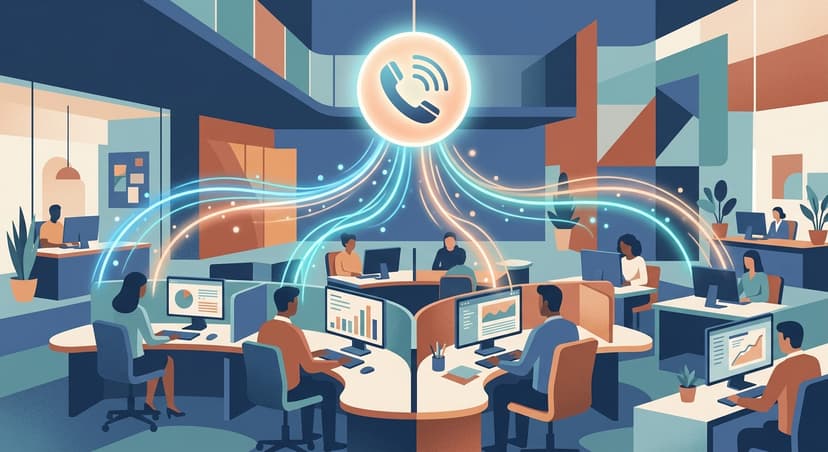
An AI receptionist for dental offices answers patient calls 24/7, books appointments into your schedule, and handles recall campaigns on autopilot. RevSquared AI costs $147/mo + $0.25/min — 85% less than a dedicated front desk hire — and captures 100% of inbound calls. Update call flows in plain English, no prompt engineering required.
Dental practices miss 30% of inbound calls on average. At $1,200 per new patient — the industry benchmark for lifetime value — a practice fielding 50 new patient inquiries a month and missing 15 of them is leaving $18,000 on the table every month. That is not a staffing problem. That is a systems problem.
This guide covers the operational details: how a dental AI receptionist handles intake calls, how to write the insurance answer that keeps patients in the conversation, how to run recall campaigns that fill your schedule, and how to manage call behavior across multiple locations — all without a developer or a support ticket. If you want a broader overview, our earlier AI receptionist for dental offices post covers the fundamentals.
The dental practices growing fastest are not outspending on ads. They are out-converting on calls — answering 100% of inquiries and booking before the patient has a chance to call the next practice in Google's results.
01Why Dental Offices Lose $96K+ in New Patients Every Year
Dental offices have a conversion problem disguised as a revenue problem. The marketing works. Patients call. Then nobody answers.
The front desk is handling a patient at the counter, on hold with an insurance carrier, or out to lunch at the moment a new patient calls. That caller waits two rings, hears voicemail, and calls the practice below them in the search results. Data from Oral Health Group puts this missed-call revenue loss between $96,000 and $180,000 annually for the average practice.
The math is straightforward. If your practice receives 40 new patient calls per month and misses 30% of them, that is 12 callers gone. At $1,200 average lifetime value, you have left $14,400 on the table that month. Over 12 months, that is $172,800 — before factoring in referrals, hygiene reactivations, or the downstream treatment cycles those patients would have generated.
After-hours is the worst window. Over 40% of patient call attempts happen outside standard office hours — evenings, weekends, and the lunch window from noon to 1:30pm. During those hours, you are invisible unless an AI answers every call.
02How an AI Receptionist Handles Dental Patient Calls
A dental intake call follows a predictable flow. A well-configured AI receptionist handles each step without hesitation.
New patient intake:
- Confirm new or existing status
- Capture name, date of birth, contact number, and reason for visit
- Ask: "Will you be using dental insurance, or are you self-pay?"
- Book into an open slot via Google Calendar or your practice management system
- Confirm the appointment and send a text with the details
- Identify by phone number
- Route based on reason: appointment change, billing question, prescription follow-up, or clinical concern
- For urgent or clinical issues: collect callback info and flag for staff
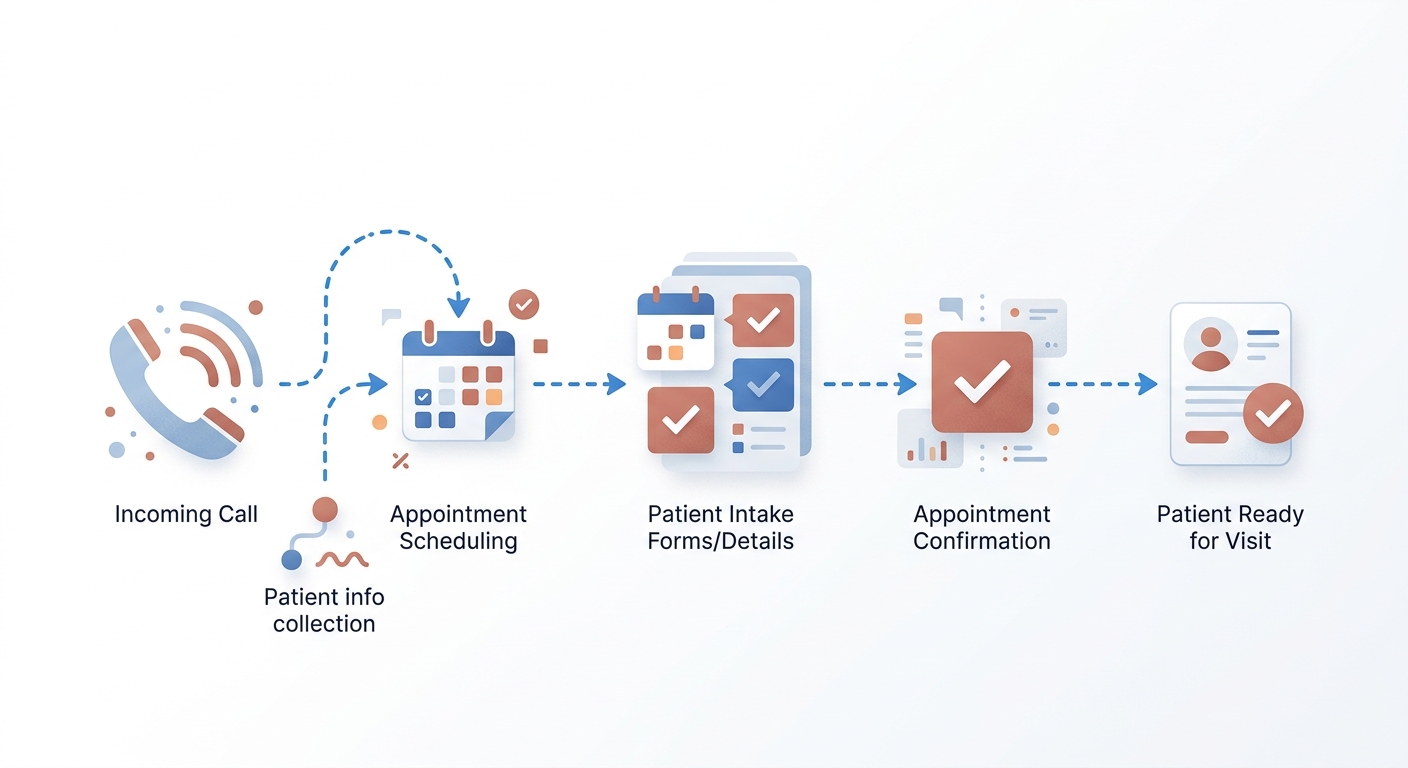
The difference between a booked appointment and a lost patient is often one unanswered call. At $1,200 per new patient, every missed call is a $1,200 decision.
03The Insurance Question That Kills 30% of First Calls
Insurance is the conversation killer in dental intake. Patients want to confirm their plan is accepted before they book. Generic AI platforms cannot handle this reliably — they either give a canned "we accept most major plans" non-answer that patients ignore, or they route to voicemail the moment insurance is mentioned. Either response ends the call.
Here is how to solve this with RevSquared. In your prompt adjuster, define your accepted carriers explicitly:
*"If a patient asks about insurance, tell them we accept Delta Dental, Cigna, Aetna, Humana, and MetLife. If they mention a different carrier, tell them we are happy to check their out-of-network benefits and that many patients with alternative plans pay less than $150 out of pocket for a cleaning. Then offer to book a complimentary benefits check."*
That instruction is live in 10 seconds. Update it anytime — when you add a carrier, drop one, or adjust your messaging.
| Patient Insurance Question | Generic AI Response | RevSquared Response |
|---|---|---|
| "Do you take my insurance?" | "We accept most major plans" | Lists your carriers + out-of-network option |
| "How much will a cleaning cost?" | Price range or routes to voicemail | Offers benefits check and books appointment |
| "Is this covered under my plan?" | "Please call your insurance provider" | Collects info, books benefits check, keeps patient in flow |
| "I have Medicaid — do you take it?" | Generic error or no response | Responds per your plain-English instruction |
| "I'm uninsured" | Transfers or gives rates | Offers payment plan info and books appointment |
The insurance question ends 30% of first calls on template AI systems. Write the answer once in plain English and it handles every variation automatically — no dev ticket, no waiting.
04Recall Campaigns: Turning Dormant Patients Into Booked Appointments
The average dental practice has 500 to 2,000 patients in their system who have not been seen in 18 months or more. That is a revenue stream sitting idle.
Recall campaigns are outbound calls to those patients — automated, timed to a window you define, and scripted to book directly into your calendar. A basic recall script:
*"Hi, this is an automated reminder from [Practice Name]. You are due for your 6-month cleaning. We have openings this week. Would you like me to grab you a time now?"*
If they say yes, the agent books the appointment immediately. If they say "call me back next week," the agent reschedules the outreach. If they opt out, the call is flagged for your front desk to update the record. No manual dialing. No separate recall platform.
Dental Economics consistently cites recall campaigns as one of the highest-ROI activities available to general practices — automated contact within 30 days of an overdue date brings back 25-35% of lapsed patients. RevSquared's Growth tier includes outbound AI for exactly this: one system handles both inbound patient calls and outbound recall.
05Managing Multiple Locations Without Prompt Engineering
Multi-location practices and DSOs face a specific challenge: each office has different hours, different providers, different insurance panels, and different appointment types. Managing five AI agents across five locations sounds like a developer project.
With RevSquared, it is not. Each location gets its own agent, configured through the same dashboard, updated in plain English. "Lincoln Park is closed Saturdays in July." Done. "Naperville no longer accepts HMO plans." Done. "Dr. Chen is on leave until the 20th — do not book new patients with her." Done.
Changes go live in seconds, not hours or days. You do not open a support ticket or wait for a configuration team. Our Pro plan supports up to 3 inbound agents. Growth supports unlimited custom builds with full multi-location configuration. See how this same approach works in AI receptionist for healthcare practices if you manage mixed specialty groups.
Plain-English updates mean your office manager is the system administrator. That is the operating model dental practices actually need — not one that routes every behavior change through a dev team.
06The ROI Math: What One New Patient Is Worth
| Metric | Before AI | After AI |
|---|---|---|
| Monthly new patient calls | 50 | 50 |
| Calls answered | 35 (70%) | 50 (100%) |
| Booking rate from answered calls | 50% | 55% |
| New patients booked per month | 18 | 28 |
| Avg new patient lifetime value | $1,200 | $1,200 |
| Monthly new patient revenue | $21,600 | $33,600 |
| Monthly AI cost (Starter + ~$75 in minutes) | — | ~$222 |
| Net monthly gain | — | ~$11,778 |
These are conservative assumptions. Coastal Dental, a multi-location group running RevSquared, reported 100% call capture in their first month — up from an estimated 65% before the AI. At higher call volumes or higher lifetime values, the gap widens further.
The Starter plan at $147/mo fits solo practices and single locations. The Pro plan at $497/mo makes sense once you are running recall campaigns alongside inbound or managing multiple agents. See RevSquared's plan comparison for the full breakdown.
At $1,200 per new patient and 10 additional bookings per month, the net monthly gain from an AI receptionist runs ~$11,778 after the AI cost — from calls that were previously going to voicemail.
07Getting Set Up in Under 5 Minutes
Most dental AI platforms require a setup call, a deployment window, and a dedicated onboarding period. Some take weeks. RevSquared takes five minutes:
1. Go to platform.revsquared.ai/agents/new 2. Choose a voice and name your agent 3. Paste your call flow in plain English — or start with our dental intake template 4. Connect Google Calendar for direct appointment booking 5. Forward your main practice line to your new agent number
The agent handles calls the same day. As you learn what patients are asking — and what is breaking — you update the agent in real time. If you run Google Local Services Ads, your AI receptionist also handles the phone response score requirement: every call answered, every callback logged.
For a deeper look at the dental industry AI landscape, our industry page covers the integration ecosystem and use cases beyond front-desk calls.
Your front desk manager can change agent behavior by typing a sentence. That shifts the ongoing operational cost from a developer at $150/hr to a person already on your payroll.
08Bottom Line
Dental practices are not losing patients because of poor clinical care or weak marketing. They are losing patients because a phone rang and nobody answered. An AI receptionist that captures 100% of calls, writes the insurance answer patients actually want to hear, and books directly into your schedule is not a future investment. It is what top-performing practices are already running.
Start a 7-day free trial at RevSquared and see what your call capture rate looks like when every call gets answered.
09Frequently Asked Questions
What can an AI receptionist do for a dental office?
A dental AI receptionist handles inbound patient calls 24/7, books appointments directly into your schedule, answers insurance questions based on your accepted carriers, routes urgent calls to on-call staff, and runs outbound recall campaigns to patients who are overdue for care. With RevSquared, you update all of this behavior in plain English — no coding, no support tickets, no waiting 24-72 hours for a change to go live.
How much does an AI dental receptionist cost?
Most dental AI platforms run $200 to $800 per month. RevSquared AI starts at $147/mo on the Starter plan, plus $0.25 per minute of call time. For a typical solo practice handling 300 minutes of call volume per month, the total cost runs approximately $222 — compared to a dedicated front desk hire at $3,000 to $4,500 per month including benefits.
What is the best AI receptionist for dental offices?
The best dental AI receptionist handles the insurance question without routing to voicemail, books directly into your schedule, and lets you update call logic in plain English without developer help. Platforms like Dentina, Viva AI, and Annie AI are built exclusively for dental but use fixed templates that require dev involvement to change. RevSquared is not dental-specific but handles dental call flows through plain-English prompts any office manager can update in real time — and the agent improves itself from every call.
Can the AI handle dental emergencies?
Yes — and you control how. Define the emergency protocol in plain English: "If a patient reports severe pain, swelling, or a knocked-out tooth, collect their name and callback number, tell them a team member will call back within 15 minutes, and flag the call as urgent." That instruction is live in seconds and the AI follows it exactly as written, every time.
Do I need to cancel my answering service before switching?
No. Run RevSquared alongside your current system for the first 30 days, compare call capture rates side by side, then cancel the answering service once the data confirms the switch. The 7-day free trial lets you test with real patient call volume before committing to anything.
The 2026 Google LSA Playbook
Dominate your local competition, rank #1 on Google Local Services Ads, and turn Google into your top salesperson. Built for dental practices.
Get It Free
Try RevSquared free for 7 days.
Set up your agent in under 5 minutes. Live on your existing number. No contract.