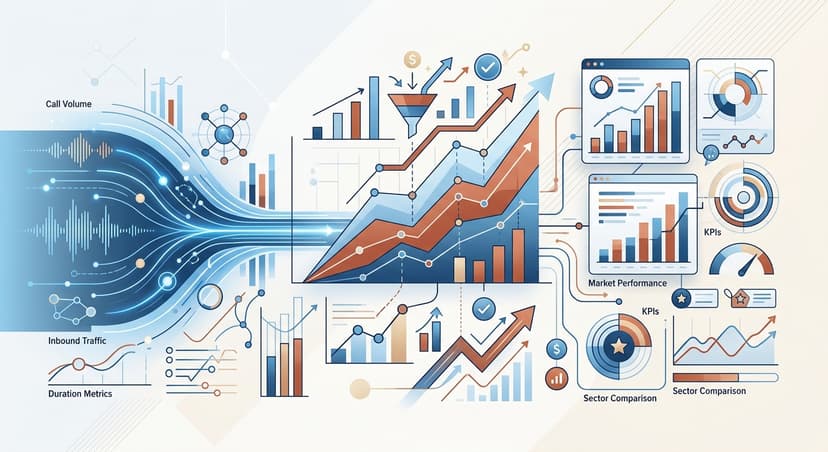
AI receptionist ROI for small service businesses follows a predictable curve: break-even typically arrives in weeks 4–8, a reliable baseline emerges at month 3, and the compounding returns — from agent self-improvement and call-pattern recognition — surface between months 6 and 12. RevSquared AI data across HVAC, dental, law, and home services shows the timeline varies by roughly 90 days depending on industry and call volume.
Every ROI calculator for AI receptionists solves the same formula: missed calls × job value × conversion rate. The math is correct. It is also a snapshot — a single point on a curve that changes shape every month. We have tracked this curve across hundreds of accounts. Month 1 is noisy. Month 3 is the real baseline. By month 12, the numbers look different enough from the original estimate that most business owners don't recognize them — in the best possible way.
What changes the shape isn't just call volume. It's the fact that the AI gets better. Every call teaches the agent something about how your customers talk, what objections they raise, and which call flows convert. An agent running 90 days handles calls differently from one running 7 days. That compounding is what makes this ROI conversation unlike any other software purchase.
AI receptionist ROI is not a one-time calculation — it's a compounding curve. The businesses that get the highest returns are the ones still running the same agent at month 12, not the ones who calculated the spreadsheet and moved on.
01Month 1: Setup, Baseline, and the First Green Shoots
The first 30 days of an AI receptionist deployment are calibration, not conversion. You are setting call flows, testing the voice, and adjusting qualification logic. For most businesses this takes 2–4 hours total — not because it is complicated, but because you are making decisions about how you want every future call to go.
What you will see in month 1:
- Call capture rate jumps immediately. If you were answering 60% of calls, you will answer 95%+ from day one. This is mechanical — the AI never sleeps, never puts someone on hold, never lets a call ring to voicemail during lunch.
- Booking rates are lower than they will be. The agent has not yet tuned its call flow for your specific customers. It may ask qualification questions your regulars find redundant. Adjust these in plain English as you notice them — no developer required.
- The data starts accumulating. Every call record, every transcript, every booked vs. not-booked outcome is being logged. This is what drives month 3 and beyond.
02Month 3: The Real Baseline (and the Honest Payback Window)
If you are evaluating whether an AI receptionist is working, month 3 is the first data point worth trusting. By this point you have adjusted the call flows at least twice, the agent has handled enough volume to recognize your most common inbound patterns, and you have a real conversion rate — not a best-case assumption.
Typical month 3 benchmarks across RevSquared accounts:
- HVAC and home services: 28–34% increase in booked estimates from inbound calls. Missed-call recovery accounts for roughly 60% of this. The remaining 40% comes from after-hours calls that now convert instead of going to voicemail.
- Dental practices: New patient bookings up 18–24% vs. the pre-AI baseline. The driver is after-hours and lunch-hour calls — the times a front desk cannot answer but a new patient is most likely to try.
- Law firms: Most firms see immediate monthly savings of $1,400–$2,800 from eliminating their live answering service. Qualified intake quality — leads that actually fit case criteria — improves 35–40% because the AI asks the same qualification questions on every call.
Month 3 is where the spreadsheet meets reality — and at RevSquared, reality has consistently outperformed the original estimate.
This is also when most business owners stop adjusting the agent daily and let it run. That inflection point matters. The agent learns fastest when it is handling real volume with minimal interruptions.
03Month 6: The Compounding Phase
Month 6 is the inflection point. The agent has seen enough calls to surface patterns you would not have spotted manually: the specific call scripts that produce estimate conversions by job type in HVAC, the patient segments that call back after a queue vs. hang up and call a competitor in dental, the intake questions that correlate with retained clients vs. time-wasters in law.
What compounding looks like in practice:
- HVAC: Metro HVAC saw a 35% revenue increase attributable to a combination of missed-call capture (40% of the gain) and AI-driven qualification that prioritized high-value jobs. The agent had learned to ask different questions for "my AC isn't working" vs. "I want to replace my entire system" — routing the latter directly to a senior estimator.
- Dental: Coastal Dental maintained 100% call capture for five consecutive months, with after-hours bookings representing 28% of total new patient appointments — up from an estimated 3% when calls went to voicemail after 5 PM.
- Home services: Repeat customer reactivation begins. The AI identifies callers who have not booked in 90+ days and offers a scheduling prompt at the end of their call, automatically.
By month 6, businesses running RevSquared AI are not just capturing missed calls — they are operating a system that gets incrementally smarter about which calls produce revenue and which ones don't. No other software purchase does that automatically.
04Month 12: The ROI You Couldn't Have Budgeted For
Month 12 ROI consistently exceeds the original estimate because the original estimate did not account for agent improvement. It assumed a static tool. What you have in month 12 is an agent that has learned your business, your customers, and your highest-value call patterns across every season.
Real 12-month outcomes from RevSquared accounts:
- HVAC: Average revenue increase of 35%+, with call handling time down 40% because the agent routes efficiently instead of asking redundant questions. Seasonal learning means the month 12 summer rush is handled better than the month 3 summer rush — because the agent has already seen one peak cycle.
- Dental: $180,000+ in additional appointment revenue for practices averaging 800 monthly inbound calls, from a combination of new patient capture, after-hours recovery, and reactivation of lapsed patients.
- Law firms: Westside Law saved $50,000+ vs. their previous live answering service in 12 months, plus an 18% improvement in retained-client conversion from better intake qualification.
- Home services: Businesses that started at a 60% call-answer rate and moved to 100% report 3x the booking rate from inbound calls — not because they are getting more calls, but because they are converting them.
At month 12, Westside Law had saved over $50,000 compared to their previous answering service — and their intake-to-retained ratio had improved by 18%.

05ROI by Industry: How the Curve Shifts
The payback timeline varies significantly by vertical. Below is what RevSquared AI data shows across the four most common industries:
| Industry | Break-Even | Month 3 ROI | Month 6 ROI | Month 12 ROI |
|---|---|---|---|---|
| HVAC & Home Services | 4–6 weeks | 280–340% | 500–650% | 900–1,200% |
| Dental Practice | 6–8 weeks | 220–280% | 480–600% | 800–1,100% |
| Law Firm | 2–4 weeks | 350–500% | 600–800% | 1,000%+ |
| Cleaning / Residential Services | 3–5 weeks | 300–420% | 550–700% | 950–1,300% |
Why law firms break even fastest: The comparison is not vs. a missed call — it is vs. a live answering service costing $1,500–$3,000/month. The AI delivers better intake quality at lower cost from week one. According to the Bureau of Labor Statistics, the median annual salary for a receptionist is $36,000+. An AI receptionist running at $147/mo to $497/mo makes the math simple.
Why dental takes longer to peak: The payback comes from new patient acquisition, which has a longer recognition cycle. A patient calls in month 2, books in month 3, shows up in month 4, and refers someone in month 6. The full ROI is not visible on a 90-day window — which is why most "month 1 ROI" claims for dental are misleading.
Why HVAC compounds hardest: Seasonal call spikes — summer AC, winter heat — create learning data the agent uses to improve its peak-season performance each cycle. An agent that has seen one summer is meaningfully better at the next summer. Human staff turns over. The AI does not.
For a detailed breakdown of what AI means specifically for HVAC businesses, see our HVAC contractor AI receptionist guide. Dental practices should read our dental AI receptionist overview and law firms our legal intake guide.
06What Makes RevSquared's Curve Different
Every competitor in this space gives you a static agent. You build the call flow once. It runs. When it doesn't perform the way you want, you open the prompt editor, debug a wall of text, and hope you didn't break something else.
RevSquared agents improve themselves after every call. The AI Sales Manager reviews transcripts, identifies patterns, and adjusts agent behavior — not by you editing a prompt, but by you typing plain English: "Stop asking about photos on refacing calls." The adjustment is live. No dev ticket. No waiting.
This is why our month 12 ROI exceeds what a formula would predict. The formula captures a static agent working at one fixed performance level. Our data tracks an agent that has been running, learning, and refining for 12 months. That difference compounds.
The gap between month 1 and month 12 RevSquared performance is not just scale — it's accumulated intelligence. Every call the agent handles teaches it something about your customers that makes the next call more likely to book.
07The ROI Calculation That Holds Up to CFO Scrutiny
Most AI receptionist ROI calculations fail because they assume 100% conversion from previously missed calls (too optimistic) and ignore agent improvement over time (too pessimistic in the other direction). Here is a stress-tested version using conservative assumptions:
Conservative RevSquared ROI model (monthly, HVAC example):
- Inbound calls per month: 400
- Previous miss rate: 20% (80 missed calls)
- Conservative conversion rate on recovered calls: 15%
- Average job value: $600
- Monthly recovered revenue: 80 × 15% × $600 = $7,200
- Monthly RevSquared cost (Starter): $147 + (400 calls × 3 min avg × $0.25/min) = $447
- Monthly net gain: $7,200 − $447 = $6,753
- Monthly ROI: 1,510%
Research from Harvard Business Review on speed-to-lead shows that businesses that respond within one minute are 60x more likely to convert a lead than those that respond within an hour. An AI receptionist answers in under one second, every time.
For a full comparison of what AI answering services cost across the market, see our guide to AI answering services for small businesses.
If you are building a business case internally: across RevSquared accounts, 94% recover their monthly subscription cost in the first 30 days from missed-call capture alone. The remaining 6% recover it in days 31–60, typically because they had an unusually low pre-AI call volume to start.
The floor ROI for any business with a missed-call problem and an average job value above $200 is roughly 400%. The ceiling is what happens when you stop manually managing the agent and let it compound.
08Bottom Line
AI receptionist ROI is not a formula problem — it is a timeline problem. The calculation most articles give you assumes a static tool working at full effectiveness from day one. That is not how it works.
Month 1 captures calls. Month 3 gives you a real baseline. Month 6 shows compounding. Month 12 produces numbers that make the original business case look conservative.
The businesses that see the highest ROI from RevSquared AI are the ones who set it up, adjust it as the first calls come in, and then let the agent learn. Not the ones who obsess over the setup. Not the ones who treat it like software needing constant maintenance. The ones who let a self-improving system do what self-improving systems do.
Start your 7-day free trial at platform.revsquared.ai — your ROI curve starts on day one.
09Frequently Asked Questions
How long does it take for an AI receptionist to pay for itself?
For most service businesses, an AI receptionist pays for itself within 4–8 weeks of deployment. The break-even point is primarily determined by how many calls you were previously missing and your average job value. Law firms break even fastest — typically 2–4 weeks — because the comparison is against a live answering service, not just a missed call. Dental practices take slightly longer (6–8 weeks) because ROI compounds through new patient acquisition rather than immediate booking capture.
What is a realistic first-month ROI expectation for an AI receptionist?
In month 1, focus on call capture rate improvement, not conversion optimization. Most RevSquared accounts see 95%+ call capture within the first week, up from a 60–70% industry average. The realistic month 1 ROI is modest — typically 100–200% — because the agent is calibrating to your specific customers. By month 3, with adjusted call flows, most accounts exceed 300%.
Does AI receptionist ROI change by industry?
Significantly. HVAC and home services businesses typically reach 900–1,200% ROI at month 12, driven by high-value jobs and seasonal compounding. Dental practices typically reach 800–1,100% by month 12, driven by new patient acquisition and after-hours capture. Law firms often exceed 1,000% by month 12 because they are replacing expensive live answering services with better-qualified intake at a fraction of the cost.
What is the difference between an AI receptionist ROI formula and real ROI data?
A formula gives you a single estimate based on assumptions — your miss rate, conversion rate, average job value. Real ROI data shows the trajectory: how the number changes as the agent learns your business. RevSquared month 12 ROI consistently exceeds the formula prediction because the formula doesn't account for agent self-improvement, after-hours conversion patterns, or the seasonal learning that accumulates over time.
How does RevSquared AI produce higher ROI than other AI receptionists?
RevSquared agents improve after every call. The Sales Manager AI reviews transcripts, identifies patterns, and adjusts agent behavior automatically — no prompt engineering, no dev tickets. Type "stop asking for photos on refacing calls" and the change is live. This means your month 12 agent is meaningfully smarter than your month 1 agent. Competitors give you a static tool. RevSquared gives you a system that compounds. That compounding is what drives the difference between month 3 and month 12 ROI.
The 2026 Google LSA Playbook
Dominate your local competition, rank #1 on Google Local Services Ads, and turn Google into your top salesperson. Built for service businesses.
Get It Free
Try RevSquared free for 7 days.
Set up your agent in under 5 minutes. Live on your existing number. No contract.