If you're comparing AI answering services for your business, Hey Rosie is probably on your shortlist. It's one of the more visible options out there, and at first glance it checks the basic boxes — an AI agent that answers calls and takes messages.
But "basic boxes" is exactly the problem.
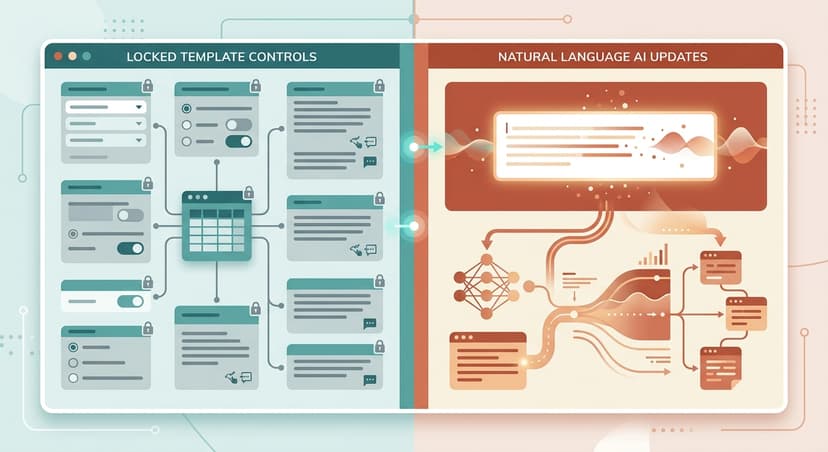
Once you look under the hood, the gap between Hey Rosie and Revenue Squared AI isn't a minor feature difference. It's an entirely different class of technology. One platform gives you a static phone script that never changes. The other gives you a self-learning AI Sales Manager that analyzes every single call and autonomously rewrites its own prompts to get better over time.
This article breaks down every meaningful difference — features, technology, voice quality, integrations, and pricing — so you can make an informed decision.
Hey Rosie answers the phone with a fixed script. Revenue Squared AI answers with an agent that rewrites its own script after every call — and six months in, that gap becomes decisive.

01The #1 Difference: Self-Learning AI vs. Static Scripts
This is the single most important difference between Revenue Squared AI and Hey Rosie, and it's not close.
Hey Rosie uses static scripts. You write a prompt (or use their template), and that's what the AI says on every call. Call #1 and call #10,000 get the exact same performance. If something isn't working — if callers are confused by a particular response, if the booking flow has friction, if objections aren't being handled well — nothing changes unless *you* manually notice the problem and rewrite the script yourself.
Revenue Squared AI has a self-learning AI Sales Manager. After every call, Revenue Squared AI's AI engine analyzes the conversation across dozens of performance dimensions — objection handling, booking conversion, caller sentiment, information delivery, and more. It identifies patterns across hundreds and thousands of calls, pinpoints exactly where performance can improve, and autonomously rewrites the agent's prompts to perform better on the next call.
This isn't a buzzword. It's a production system that's been processing millions of calls. The result is compounding improvement:
- Week 1: Your agent performs well out of the box with a custom-built prompt
- Month 1: The AI has identified and fixed friction points you never would have caught
- Month 3: Your agent handles edge cases and objections with responses refined across thousands of real conversations
- Month 6: The performance gap between your self-learning agent and any static agent is enormous
For businesses that care about conversion rates and caller experience, this difference alone makes the decision. If you want to understand the technical details behind how this works, read our deep dive on how self-learning voice AI actually works.
Hey Rosie sells a receptionist; Revenue Squared AI ships an agent — the difference is who's still learning on your behalf six months in.
02Custom-Built Quality vs. Basic Templates
When you sign up for Hey Rosie, you get a template. You fill in your business name, hours, and services, and the AI follows a generic script pattern. It works, but it sounds like every other Hey Rosie customer. The prompts aren't tailored to your specific business flow, your unique value propositions, or your industry's terminology.
Revenue Squared AI takes a fundamentally different approach. When you build your agent on Revenue Squared AI, the platform asks detailed questions about your business — your services, your ideal customer, your booking process, your FAQs, your competitive advantages, your tone preferences. Then it generates a custom prompt specifically engineered for your business.
This is the same quality of prompt engineering that voice AI agencies charge $5,000 to $20,000 to build. The difference is that Revenue Squared AI automates the entire process, delivering agency-grade prompt quality in a self-serve DIY wrapper that takes about 5 minutes.
The result is an agent that doesn't just answer calls — it sounds like it was built by someone who deeply understands your business. Because in a sense, it was. The AI prompt builder draws on patterns from thousands of successful deployments across dozens of industries to craft something specifically for you.
With Hey Rosie, you get a receptionist that takes messages. With Revenue Squared AI, you get an AI employee that sells, qualifies, books, and improves.
03Emergency Detection and Escalation
Here's a scenario that matters more than most people realize: a caller is describing what sounds like an emergency. Maybe it's a patient calling a dental office with severe pain. Maybe it's a homeowner calling an HVAC company about a gas leak. Maybe it's a property management tenant reporting a burst pipe.
Revenue Squared AI has built-in emergency detection. The AI can identify urgent language patterns, escalate the call immediately to the right person, and handle the situation with appropriate urgency — all autonomously. You define your escalation rules, and Revenue Squared AI follows them instantly.
Hey Rosie has no emergency mode. Every call gets the same treatment regardless of urgency. A routine scheduling request and a genuine emergency go through the same static flow. There's no intelligent escalation, no urgency detection, no priority routing.
For businesses in healthcare, home services, property management, or any industry where urgent calls happen, this isn't a nice-to-have. It's a liability issue. To understand what a complete AI receptionist should include, emergency handling should be near the top of the list.
A message-taker is not a receptionist. A receptionist books the job.

04Premium Voices and Voice Cloning vs. Limited Options
The voice your AI uses matters. A lot. Callers make snap judgments about your business within the first three seconds of a call, and the voice quality plays a huge role in that first impression.
Revenue Squared AI gives you access to premium voices from leading voice synthesis providers. You can browse by gender, accent, age, tone, and personality. Want a warm, friendly Southern voice for your dental practice? Done. Want a crisp, authoritative voice for your law firm? Done. Want a bilingual agent? Done.
And if the existing options aren't quite right, Revenue Squared AI offers voice cloning — upload a sample and create a custom voice that's uniquely yours.
Hey Rosie gives you essentially one voice. There's no voice selection, no variety, and no cloning capability. Every Hey Rosie customer sounds the same.
When your competitor's AI receptionist sounds like a real, professional human and yours sounds like a robot reading a script, callers notice. Voice quality directly impacts trust, engagement, and conversion rates.
A template with your business name inserted is not a custom build — it's a skin on someone else's script.
05Prompt Engineering That Actually Works
This point is related to the custom-built quality difference above, but it deserves its own section because it's so often overlooked.
The prompt is the brain of your AI agent. A well-engineered prompt means the AI handles complex conversations gracefully — managing objections, asking the right qualifying questions, providing accurate information, and guiding callers toward booking. A poorly engineered prompt means the AI stumbles on anything outside the basic script.
Revenue Squared AI's prompt builder creates genuinely sophisticated prompts. It structures the conversation flow, handles branching logic for different caller intents, includes objection-handling frameworks, embeds your business knowledge naturally into the conversation, and optimizes for conversion — not just information delivery. And then the self-learning engine continuously refines it.
Hey Rosie gives you a one-size-fits-all template. You customize the details (business name, hours, services), but the underlying prompt architecture is the same for every customer. A dental office and a law firm and a plumbing company all get the same conversational framework with different details plugged in.
The difference shows up in every conversation. Revenue Squared AI agents handle curveballs, objections, and complex multi-step conversations. Hey Rosie agents handle straightforward requests and struggle when conversations go off-script.
06Real Integrations That Actually Work
An AI receptionist that can't connect to your existing tools is just a fancy answering machine.
Revenue Squared AI offers deep, production-grade integrations:
- CRM integration — Automatically creates and updates contacts in your CRM after every call. No manual data entry, no leads falling through the cracks.
- Calendar integration — Real-time availability checking and appointment booking during the call. The AI sees your actual open slots and books directly into your calendar.
- Appointment booking — End-to-end booking flow that handles date/time selection, service type, and confirmation — all within the conversation.
- Custom workflows — Connect Revenue Squared AI to your existing business systems and automate post-call actions.
Hey Rosie's integration capabilities are more limited. Basic message-taking and notification features exist, but the deep, real-time integrations that allow the AI to take action during the call — like live calendar availability and instant booking — aren't at the same level.
For a detailed look at what a fully-integrated AI receptionist should do, our guide to the best AI answering service for small business covers the integration requirements in depth.
"We have integrations" is not the same thing as "we booked the appointment on your calendar during the call" — one is a feature list, the other is revenue.
07Feature-by-Feature Comparison
Here's a direct comparison of the most important capabilities:
| Feature | Revenue Squared AI | Hey Rosie |
|---|---|---|
| Self-learning AI | Yes — AI Sales Manager rewrites prompts autonomously | No — static scripts forever |
| Custom prompt quality | Agency-grade, built for your specific business | Generic template with custom details |
| Voice library | Premium voices + voice cloning | 1 voice, no cloning |
| Voice cloning | Yes | No |
| Emergency detection | Yes — automatic urgency detection and escalation | No |
| CRM integration | Deep, real-time, bidirectional | Basic |
| Live calendar booking | Real-time availability check + instant booking | Limited |
| Prompt optimization | Autonomous, continuous, data-driven | Manual only |
| Setup time | ~5 minutes | ~5 minutes |
| Concurrent calls | Unlimited | Limited |
08Who Hey Rosie Works For
To be fair, Hey Rosie isn't a bad product. If you need a simple AI answering service that takes messages and forwards them to you, Hey Rosie does that. It's a straightforward tool for straightforward needs.
But if you need an AI agent that actually converts callers into customers — that books appointments, qualifies leads, handles objections, and gets better at all of it over time — Hey Rosie's static approach falls short.
The question isn't whether Hey Rosie works. It's whether "works" is good enough when a dramatically better option exists at a comparable price point.
If all you want is a message taker, any tool works — but "I got your message" is not why the caller picked up the phone.
09Who Revenue Squared AI Works For
Revenue Squared AI is built for businesses that treat their phone calls as a revenue channel, not just an interruption to manage. If any of these sound like you, Revenue Squared AI is the better choice:
- You care about conversion rates, not just call answering. You want the AI to actually book appointments and close leads, not just take messages.
- You want improvement over time. You don't want to manually babysit and rewrite your AI's script every week. You want it to get better on its own.
- You operate in a competitive market where the quality of your phone experience directly impacts whether callers choose you or your competitor.
- You need real integrations — CRM updates, calendar booking, appointment confirmation — that work during the call, not after.
- You handle urgent calls and need intelligent escalation when a caller describes an emergency.
10The Bottom Line
Hey Rosie is a static answering service dressed up as an AI product. Revenue Squared AI is a genuine AI platform with self-learning capabilities, agency-grade prompt engineering, premium voices, emergency detection, and deep integrations — all available in a self-serve package that takes 5 minutes to set up. Voice cloning is available on Pro ($497/mo) and above.
The performance gap starts on day one and widens every single day after that. Revenue Squared AI's AI Sales Manager learns from every call. Hey Rosie's script stays exactly the same.
If you're currently using Hey Rosie — or evaluating it — build a Revenue Squared AI agent in 5 minutes and test it yourself. Compare the voice quality, the conversation intelligence, and the booking conversion. Then check back in 30 days and compare how much your Revenue Squared AI agent has improved versus your Hey Rosie agent.
The data will speak for itself.
Start your Revenue Squared AI 7-day free trial today and see why businesses are switching from static scripts to self-learning AI.
11Frequently Asked Questions
Q: Which is better, RevSquared AI or Hey Rosie?
A: RevSquared AI is better for businesses that want their AI receptionist to improve over time. Hey Rosie uses static scripts; RevSquared AI uses self-learning AI that analyzes every call and refines the agent automatically.
Q: Does Hey Rosie have self-learning AI?
A: No. Hey Rosie's AI uses fixed prompts. RevSquared AI is the only major AI receptionist that automatically rewrites its own prompt after every call to improve performance.
Q: Is RevSquared AI cheaper than Hey Rosie?
A: Pricing is similar at the entry level. RevSquared AI Starter is $147/mo + $0.25/min with self-learning AI included — Hey Rosie comparable plans don't include self-learning.
Try RevSquared free for 7 days.
Set up your agent in under 5 minutes. Live on your existing number. No contract.